

Teaching adaptations in your middle school classroom? I have some ideas for you! To be honest, I’ve been avoiding posting about this area of science. Why? It can be controversial. Well, maybe not adaptations themselves, because there is no denying adaptations, but just the unit of the theory of evolution and all!
I’ll preface this post by stating that I am a Christian. I have my own thoughts about this unit as a whole, but as a teacher, I believe in teaching students the data and solid information that scientists have gathered over the years and some of the controversy behind it. Students deserve to see the whole picture!
Ok, so luckily for this post, it’s not so controversial. Adaptations are absolutely amazing. As a Christian, I believe that God has designed organisms to be able to adapt to their surroundings and adjust as needed. There are truly some fascinating things in nature.
Time to bring the WOW Factor! In this post, I will share some WONDER strategies with you to help your students become curious about adaptations and natural selection. Second, I will share an interactive lesson that will introduce your students to different physiological, behavioral, and anatomical adaptations in plants and animals. Finally, I will share some WIDEN activities so your students can go above and beyond learning about this topic.
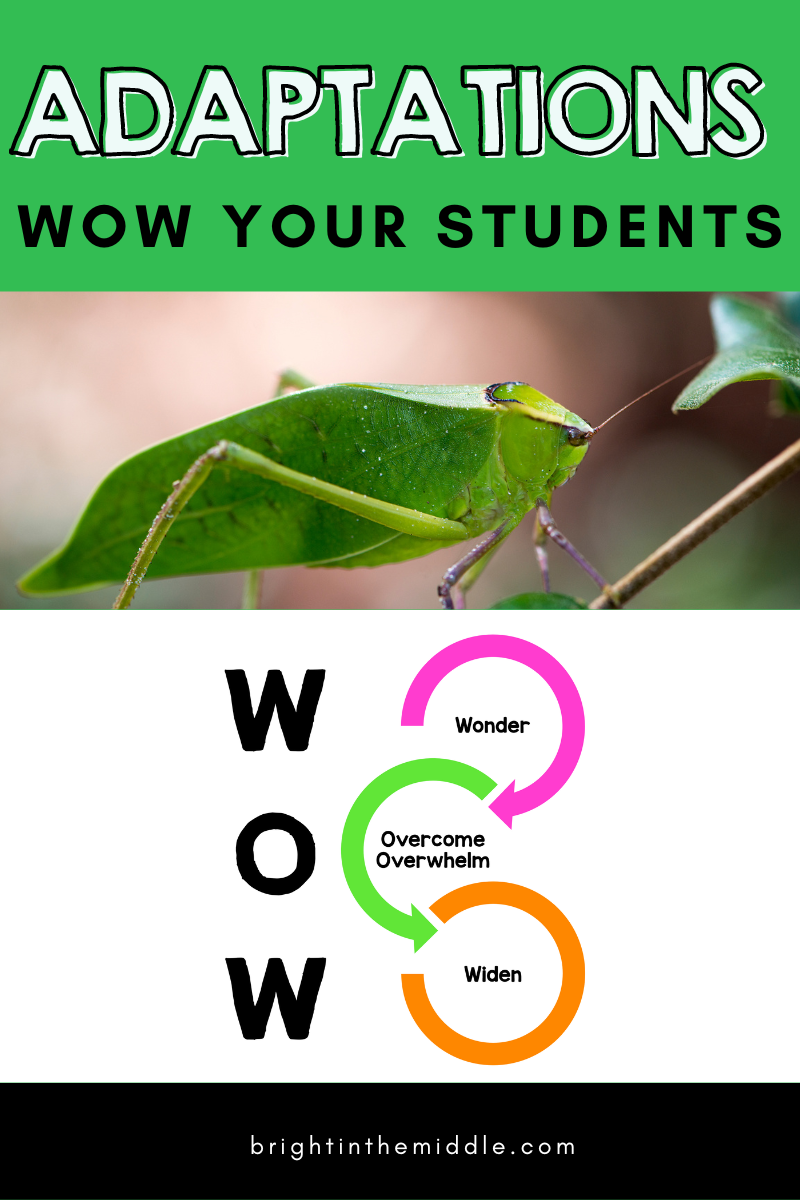
Adaptations Activities for WONDER Strategies
Are your students “not-so-excited” sometimes when learning? That is what WONDER strategies and activities are for! They help your students become internally motivated to learn! They help your students to become curious about the topic and want to know more! Here are two activities to try in your classroom before teaching about adaptations.
Camouflage Examples Gallery Walk
One of the absolute coolest anatomical adaptations in both plants and animals is camouflage. The ability to blend in with the environment helps organisms to survive.
So, let’s introduce that to your students!
You’ll need:
- pictures of animals and plants with camouflage adaptations
- paper or science notebooks for students to record their observations
- optional: magnifying glass for students for closer examination
Some examples of organisms that have this adaption are the leaf-tailed gecko, katydid, stonefish, pepper moths, walking stick insects, common baron caterpillar, orchids, sea hare, and common hazel.
- Collect about 8-10 pictures of animals and plants with camouflage adaptations. Once you have these, display them throughout your classroom.
- Make sure your students have their science notebooks or a recording sheet before they begin.
- Tell your students to move around the classroom and look for these images. Instruct them to make observations of each one and fill out their recording sheets.
- After the activity, gather your students and discuss their observations. Make sure to highlight any themes such as color matching or mimicry.
Leaf Surface Observation Activity
In this activity, students will make observations of different adaptations of plant species, specifically looking at the leaves. This activity should be completed BEFORE diving into the lesson.
You’ll need:
- a variety of leaves with different adaptations (smooth, hairy, spiny, waxy, etc.)
- magnifying glasses
- water droppers
- small trays
You’ll need to set up stations around the room with the different types of leaves. For example: Station 1: waxy leaves, Station 2: spiny leaves, etc… (except, don’t label them for students!)
- Introduce your students to a brief definition of adaptations. Your students might even know and have some background information, so ask them about it!
- Place your students into groups.
- Let students rotate through the stations and observe each set of leaves. Make sure students record their observations! They can use the water droppers to see how the leaves react to water.
- After, have a discussion with your students about their observations!
Adaptations and Natural Selection Interactive Lesson
I love interactive lessons! They are a great transition from WONDER strategies to WIDEN activities. They are simple, yet effective for middle school students. They are designed to help reduce cognitive load by using the 7 steps to help students retain information.
If you give students too much information at a time, they end up not learning anything at all. That’s why interactive lessons are designed with simplicity (with exploration) in mind. In addition, the content is segmented with multiple opportunities for students to process information! WIDEN activities will help expand the content once students have a foundation.

What are some of the adaptations of animals and plants? In this Adaptations and Natural Selection Interactive Lesson, students take a deeper dive into learning about how organisms survive in their environment. They learn about natural selection, adaptations meaning, extinction, variation, traits, mutations, and they will explore the anatomical, physiological, and behavioral adaptations in organisms. There are many animal adaptations examples.
In addition to the lesson content, there are embedded activities such as a KWL, four corners vocabulary, drag-and drop activities, and so much more!
You can find this lesson in the Bright in the Middle Shop.
You can also find this on TPT.
Adaptations and Natural Selection Activities to WIDEN Knowledge
You probably have your students doing WIDEN activities all of the time! These are activities that students participate in that allow them to apply their knowledge and/or learn more about a topic! Here are some WIDEN activities for adaptations and natural selection. Which adaptations activity will you choose?
Blubber Lab
The “blubber lab” is a fun activity that demonstrates the thick layer of fat beneath the skin of many animals. This has insulating properties! This is especially true for those that live in really cold environments, and it helps to keep them warm.
You’ll need per group:
- 2 plastic bags
- shortening or lard
- a spoon or scoop
- container of ice-cold water
- a strong tape
You can set up your students in groups for this activity!
- Explain to your students what “blubber” is.
- Instruct students to scoop the shortening into a plastic bag. It should be enough to fill the bottom (around 2 cups).
- Tell your students to place the second bag inside the first bag and move the shortening around it to surround it. It should be between the two plastic bags.
- Ask your students to fold the top of the inner plastic bag over the outer plastic bag.
- Have them to use the strong tape to create a seal between the bags.
- Tell them to place their hand into the container of cold water just as long as they can stand. It’s so cold!
- Instruct them to place their hand in the “blubber bag”, and then see how long they can keep their hand in water.
Check out this awesome video by Sick Science to learn more!
After, have a discussion or another follow up activity. CER will work great for this!
Create-a-Creature Adaptation Challenge
In this activity, students will create a creature, then debate it’s survival in a specific environment.
This is, at first, an individual activity, and then students will debate in groups!
The materials needed are:
- large paper
- markers, crayons, etc.
- timer
- Review adaptations and how animals survive in different environments.
- Explain to your students that they will be creating their own creature with different features from REAL animals and even real adaptations in humans! The creature should have physical, behavioral, or physiological traits that would thrive in an environment.
- Go ahead and put your students in groups and assign them a biome that their creature will live in.
- Then, give students about 20-30 minutes to design a unique creature!
- After they create their creatures, tell students to write down their creature’s names, a brief description of their adaptations, and how these adaptations will help them survive in the environment.
- Then, your students will get in their groups to prepare for the debate!
- Each student will take turns to present their creature to their groupmates. They should focus on explaining how it is so well-suited for their environment.
- After each students presents, see if they can work together as a group to decide which animal will be most likely to survive and why.
- Each group can present their results to the class!
Help your students master science content!

[…] Adaptations and Natural Selection […]