

So, are you teaching about the human body? What about visible light waves? When teaching these topics, one of the coolest things that you can do is talk about parts of a human eye. We all have one. We use it every day, and it’s one of the neatest parts of our body. Did you know that 80% of our memories come from things that we can see with our eyes? Some technology has been created based off of the structure of the human eye.
I would think that most of your students would love to learn about this topic, especially middle school. I mean, how gross and cool are the parts of an eyeball! This could even make a spooky Halloween lesson!
I actually teach this during the waves unit when learning about visible light waves since we can only see visible light in the electromagnetic spectrum, but it really can be taught anytime.
In this post, I will give you some ideas so that you can bring that WOW factor to your classroom and get your students excited about learning the parts of a human eye! First, I will give you some ideas to hook them in and help them to wonder about the parts of a human eye and their functions. Next, I will show you how you can take a lesson, reduce student cognitive load, engage students in the lesson, and reduce their overwhelm! Finally, I will give you some ideas to widen their knowledge on the parts of the human eye.
Before Answering the Question: What are the Parts of Your Eyes?
If you follow me at Bright in the Middle,, you will know that I am a HUGE fan of getting students hooked into the lesson and activating their prior knowledge before diving into the notes and the content. This lesson is no exception. So, here are some fun ideas that you can bring into your classroom. You can choose one of them to do before the lesson or do all of them! It’s up to you and what best fits your classroom to get your students to WONDER.
Pictures of Different Wavelengths
At this point in your unit, your students may have already learned about the electromagnetic spectrum and visible light, but why do we only see certain wavelengths? How can we actually see photos taken in other wavelengths?
To get students excited about the human eye, you can first have them to look at pictures in different wavelengths such as UV, infrared, and radio. If you really want to get fancy, you can show them some pictures taken with different NASA telescopes and probes.
- The Chandra X-Ray Observatory can detect X-ray emissions for the universe.
- The Hubble Telescope observes at ultraviolet, visual, and near-infrared wavelengths.
- The Spitzer Space Telescope explores space through infrared light.
Here’s a picture of our Sun at different wavelengths!
So, it’s cool that although our human eyes can only see visible light, we can use technology to observe other wavelengths on the electromagnetic spectrum.
Get them thinking about how it’s possible to see the pictures of images at different wavelengths but not the actual thing itself.
You can reference this blog for discussion.
Optical Illusions
What cooler way to introduce the human eye, the parts of the eye, and their functions than to see how our very own eyes can play tricks on us! How? We can use optical illusions.
There are a TON of optical illusions that you can choose from. Here is a neat site for kids. You can also find a lot of printables online.
You can choose to look at optical illusions individually or as a class.
After your students’ eyes have been tricked, they can learn a little more here!
Pupil Observation
Another cool way to introduce this topic to your students is to let them make another observation of their own (and their classmates!) eyes. This one is pretty easy to do. You would be surprised how many students have never done this before.
- First, have your students find a partner.
- Once they have a partner, they should look at each other’s eyes. What do they observe about that black hole in the middle?
- Have students close their eyes, and even cover them with their hands, for about 3-5 minutes. You can read them a story during this time, play a Disney song, or just have them to think about something.
- After this, have students to observe their partner’s eyes. What happened? They should get bigger, but why?
If your students are curious, you are doing the right thing! It’s now time to teach the lesson!
What are the Parts of The Human Eye – Interactive Lesson
My favorite way to let students take science notes and to read through content is through interactive lessons. In this Human Eye and Optics lesson, students will learn about the structure of the eye and optics. Students will explore the question, “What are the main parts of the human eye?”. They will learn about how the eye works, the sclera, cornea, pupil, iris, lens, retina, and optic nerve. They will also look at a parts of the human eye diagram.
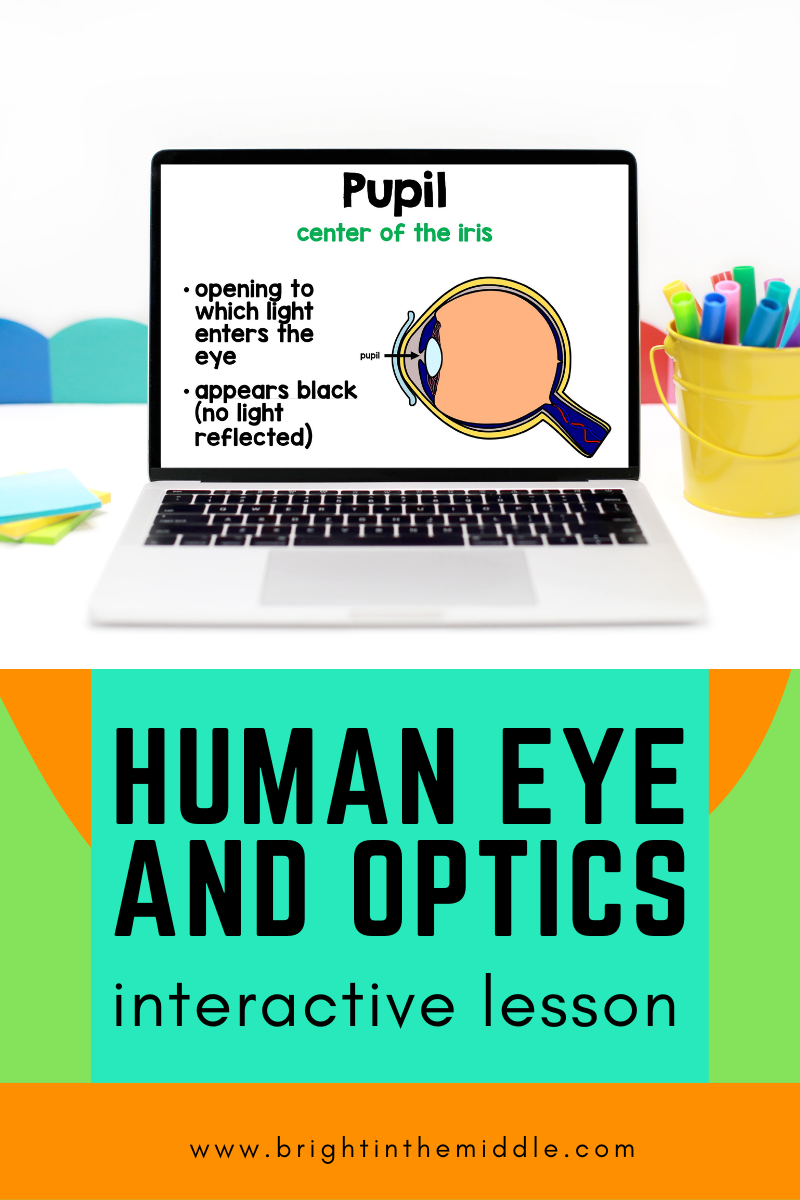
In addition, they will learn about optics and different optical instruments such as the microscope, telescope, camera, and lasers.
There are so many goodies in this lesson.
So, what makes this interactive lesson so different from the others? It focuses on reducing students cognitive load, engages students in the content, and helps them to retain information and store it in their long-term memory.
How? The content is broken down into chunks with embedded research-based activities. Students are able to process the information and practice the material. In this lesson, students explore outside resources, practice with the parts of the human eye labeled, complete and anticipation guide, and so much more!
What Do the Different Parts of The Eye Do? – Activities
Now that your students can name the parts of a human eye and what they do, it’s time for them to show off! There are so many activities that your students can do to help them to widen their knowledge on the topic and apply what they have learned. Here are 3 fun ideas!
Parts of a Human Eye? Dissect an Eye (not humans!)
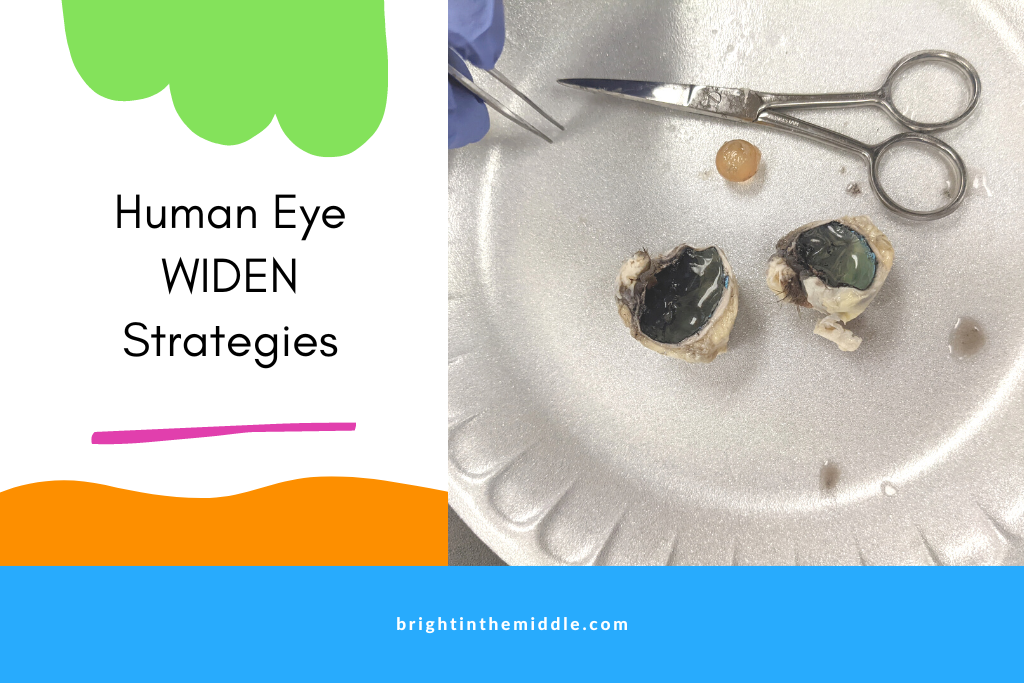
Ok, this is my favorite! It’s great for anytime of the year, especially spooky season. You can either do a sheep eye or cow eye, but the sheep eyes are a lot cheaper, and you can really see some good stuff.
You also do not need too much fancy equipment. Just gather these things.
- paper plates
- gloves
- safety goggles
- dissecting scissors
- dissecting forceps
- a sheep eye
That’s it! I used grant money for these, but you don’t have to use all of these items for this dissection.
- Place your students into groups of 2-3.
- Give them their gloves and vented safety goggles first.
- Give them a prepared plate with a sheep eye, dissecting scissors, and dissecting forceps.
- Have students to just observe. Some students’ eyeballs may have eyelashes!!
- See if they can find the optic nerve.
- Your students will need to cut a circumference around the eye. (I personally like to puncture a hole in the eye where they can start to cut. It helps to prevent injuries.)
- Once students have the eye open, see if they can find the vitreous humor, iris, pupil, cornea, and lens. They will be surprised at how tough the lens is.
- Let them explore and identify more things. See if they can find the shiny part at the back of the eye (tapetum lucidum). Explain that this is to help sheep see in the dark. We don’t have this!
This lab is so much fun. You can check out this video for help.
Tips:
- Make sure to remind your middle school students that they do not need to make “turkeys” out of their gloves.
- Show them the proper way to take off gloves. Nobody takes off their gloves until the lab is over!
STEM Project – Create an Eye
This can be so much fun! Give your students a bunch of materials such as construction paper, cardboard, marbles, markers, tape, and other random materials and task your students to create a model of an eye.
Can they model the main parts such as the pupil, iris, cornea, lens, retina, and more?
Even better, can students think of any ways to improve the human eye? Have them to add their designs!
Human Eye Disorders and Diseases Research
Another activity you can do to explore the structure of the human eye further is to explore the common disorders and disease associated with it.
Students can work in partners or in groups to research common eye issue such as:
- Cataracts
- Glaucoma
- Blindness
- Amblyopia
- Astigmatism
- Color blindness
- Nearsightedness and farsightedness
- Conjunctivitis
Students can look up the disease, definition, treatments and cures, pictures, and fun facts. They can then present their findings to the class.
They can present using a presentation, poster, skit, brochure, podcast, greenscreen presentation, or any other fun way of their choice.
Which activities will you choose to teach the parts of a human eye?
Help your students master science content!

[…] The Human Eye […]