
Science vocabulary is crucial in science teaching, and as a teacher, I think it’s super important to do things to increase students’ scientific literacy, but ALSO it has to be fun. I’m all about fun and engaging strategies in the science classroom!
Vocabulary is the center of your content. If students do not understand the vocabulary, it’s going to be mighty hard to understand the material, apply it to their lives, and to make connections.
Besides hands-on activities and labs, there are many fun ways to learn about and review science vocabulary. Check out these NINE vocabulary teaching strategies.

1. Graphic Organizers
Using graphic organizers to review vocabulary is a research-based strategy used to improve science outcomes. They are effective for diverse learners and across multiple grade levels.
Students can use prior knowledge and new knowledge to either create or fill out a graphic organizer, and using this strategy can make the material make more sense and more retainable.
Here is a list of my favorite graphic organizers to use:
- Venn Diagram
- T-Charts
- Sequence Charts
- Frayer Model
- Comparison Matrices
- Circle Map
- Tree Charts
- Categorize Your Own
- Cause and Effect
- Timeline
- Flow Charts

2. Word Walls
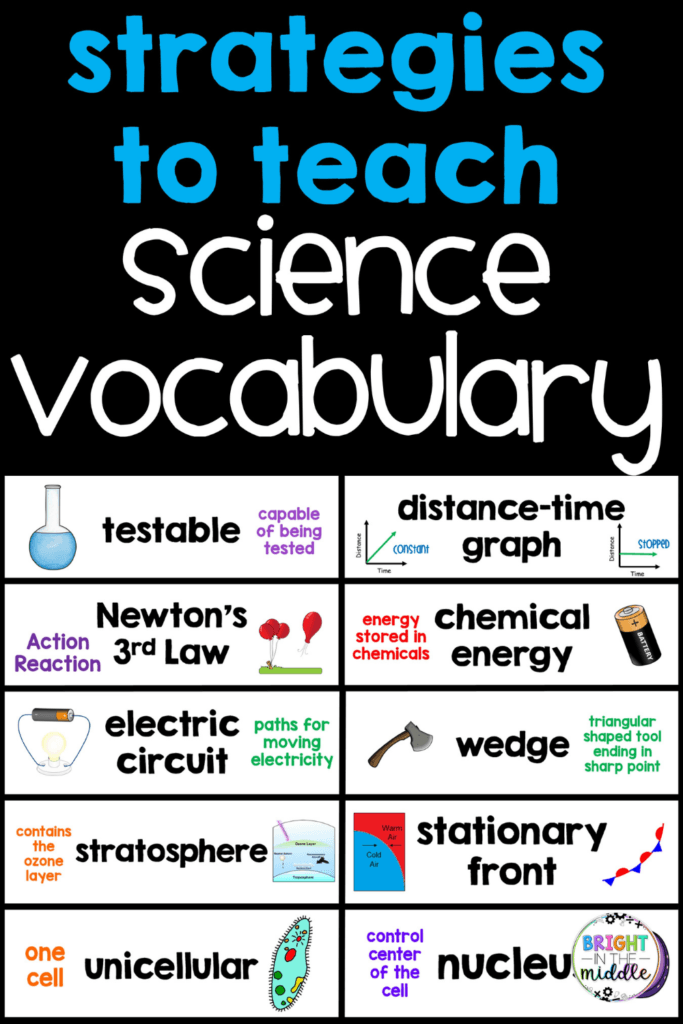
Word Walls are my FAVORITE. A word wall is a collection of words that you can post on a bulletin board, on the wall, or any surface to display in the classroom. The vocabulary words can also be accompanied by definitions and visuals.
They are great for:
- providing a permanent display of key vocabulary
- accompanying anchor charts
- aiding in spelling
- interactive games
- benefiting ELLS
There are so many awesome reasons to use word walls to teach science vocabulary.
You can also find these on TPT!
3. Word Search Puzzles
I absolutely loved word searches as a child. I remember making a game of it with my dad, my papa, and whoever else wanted to make a game out of it. We would try to figure out who could find a word the fastest!
Word searches are actually a great way to expand vocabulary. I’ve used them as a pre-unit activity, an “I’m finished activity”, and a post-unit activity. This really helps students with their spelling of science vocabulary and is a great aid for visual learners.
Word searches also build reasoning skills and promote active learning!
4. Science Vocabulary Games
I LOVE using games to teach and review vocabulary. Why, well first of all, it’s a GAME! Who doesn’t love games? Second of all, many times, students don’t even realize they are learning because they are having so much fun!
Here are five of my favorites! They are easy to do!
- Around the World : Have students stand up by their desks. Go around to each student and ask them a vocabulary question. If they get it right, they can remain standing, and if they get it wrong, have them sit down.
- Wisdom Whispers: Have a student whisper a vocabulary word and definition in another student’s ear. That person will whisper the same things to the person beside them and so on. Have the person at the end say it out loud and see if it’s the same.
- Vocabulary Bingo – For the lesson, or a unit, have students create a bingo card with vocabulary words. Don’t forget the FREE SPACE! Once students have completed their BINGO cards, read out the definitions, and students can place a “chip” on the appropriate squares. Students will yell BINGO once they have 5 in a row!
- 60 Second Word List – Students are given 60 seconds to write down as many words as they can about the lesson. The student with the most words will read it out loud and may win a prize!
- Charades – Have students act out a vocabulary word, and the others guess it. You may have to do this in small groups. Some of the students that are shy may participate in a smaller group.
5. Interactive Lessons
Interactive Lessons are PACKED with science vocabulary. In each lesson, key vocabulary is defined and reviewed in a fun way.
These lessons include pieces of information, a little at a time, followed by review of the material. This helps students decrease cognitive load. Students are able to digest pieces of the material, including vocabulary, before they move on.
They are great for:
- Individual learning
- Distance learning
- Direct instruction
- Science centers
- ELL students
- Small groups/partners
- enrichment/tutoring
I’m literally obsessed with them! Students and teachers love them! They are easy-to-follow, standards-aligned, rigorous, and fun!
You can also find these on TPT.
6. Science Vocabulary Sorts
Categorizing information is another researched-based strategy that helps students to organize their thoughts, retain information, and increase student science outcomes. Having students sort information about vocabulary words is a great way to teach and review vocabulary.
Students can use sorts for interactive notebooks, classwork, homework, and more. Teachers can use a pre-made science sort or students can create their own.
I use sorts with my toddler. We don’t use cut-and-glue type sorts at the moment, but we sort physical objects. For example, the other day, we got out six pieces of construction paper of different colors, then we sorted his blocks into those colors.
At any age, sorting and categorizing information is very helpful in the learning process!
7. Create a Song with Science Vocabulary
How fun is this! Middle school students LOVE music. Even though their taste may be a little different than mine, it is still a joy to hear their creations in the classroom.
Once thing I’ve learned about middle school students is that they are SUPER creative to the point that it will surprise you. With every chance I get, I allow them to express their creativity through a variety of ways, and one of those ways is creating songs!
You can give them this prompt.:
“Use this list of vocabulary words (provide a list), create a song, using any beat, that describes the meaning of each word and how they are connected”.
This is great for the silly classes and works well in smaller groups. I suggest creating the groups yourselves based on personalities.
8. Writing Prompts
Writing prompts are a great way to review vocabulary and to increase scientific literacy!
For example, you can use the prompt:
“Which cell organelle would you be and why? Be sure to explain how it would be better than the other cell organelles. Use at least 10 sentences.”
This will get your students creativity flowing while reviewing key vocabulary in the cell unit. Not only do they have to think of the function and definition of one cell organelle, but they have to think of the others!
Why use writing prompts?:
- You could address misconceptions.
- Writing in the science classroom will increase your students’ scientific literacy.
- You will spark creativity in your students.
- You could address misconceptions.
- Writing on a regular basis could improve writing skills.
- Students will increase their science content knowledge.
- and more!
How can you use these writing prompts:
- Warm-ups
- “I’m Finished” Stations
- Science Centers
- Quiz/Test Questions
- Extra Credit
- Review
- Homework
- Classwork
- and more!
9. Quizlet
If you have read some of my other blog posts, you probably know that I’m a fan of Quizlet. In my classroom, because I “spun” my classroom. I used Quizlet mostly as an “I’m Finished” activity. Once students completed taking their notes, many times, I had them to review their vocabulary for the unit on Quizlet.
Research shows that there is a strong correlation between academic achievement and student word knowledge. Quizlet is a great tool to use in the classroom!
Quizlet is a flashcard website and app that allows students to study using flashcards in study and game modes.
It has always been an early finisher lifesaver for me!
Teachers can create their own flashcards or search from ones already created. There are a lot of resources available on the website!
Leave a Reply