

Ready for the best properties of water lesson plan? Water is so awesome, right? I mean we need it to live, it’s delicious to drink, and it’s fun to swim in. It’s just all around amazing. What makes it so amazing? Well, there are so many properties of water that make it super special and unique. Some of those properties are polarity, adhesion, cohesion, surface tension, specific heat, density, universal solvent, phases changes, and it’s boiling, freezing, and melting point.
So, we all know water is cool, but how can you make your students really see the value and power of water and really tap into appreciating such wonderful qualities?
In this post, I am going to go over a WOW factor water properties lesson plan that you can use to teach the properties of water in a way that allow your students to get excited about the properties of water and begging to learn more!
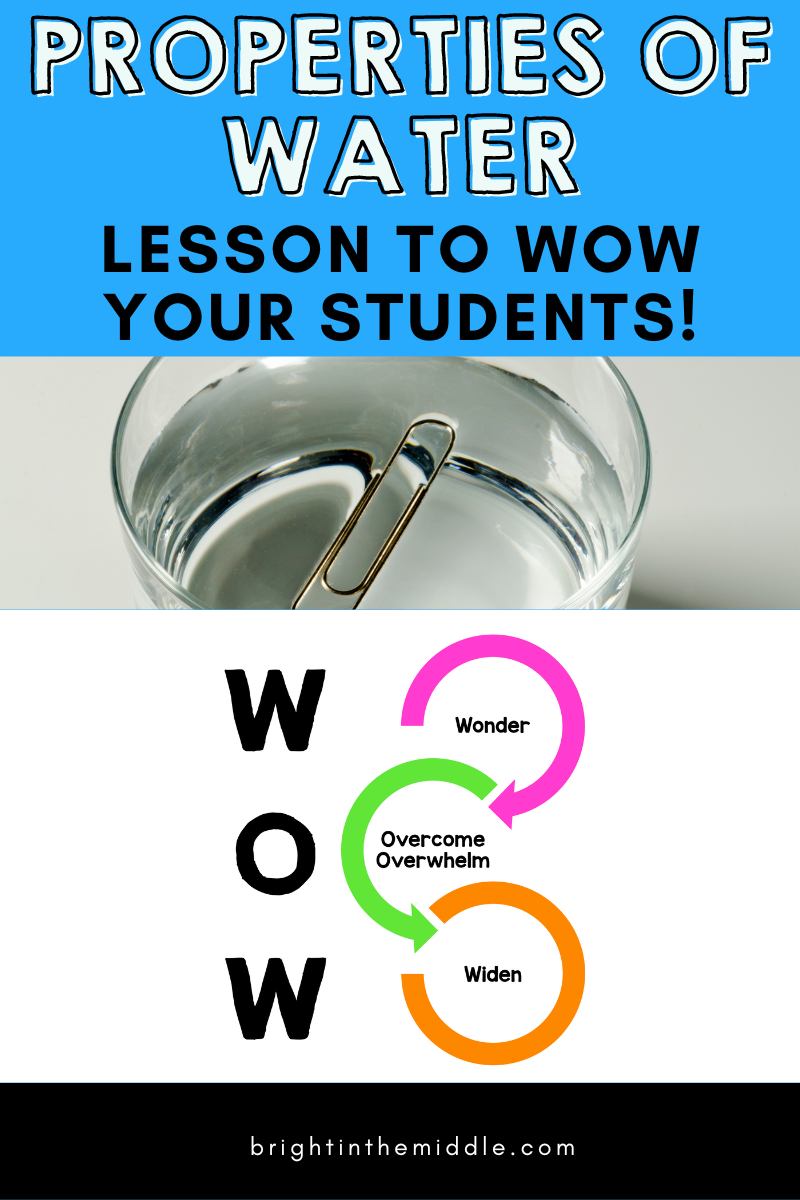
What are Water Properties? – Making Students WONDER
The first thing that you have to do is to help your students to be curious about the properties of water and make them excited to learn about the topic. You have to make the WONDER. I have three different ideas that you can use to get them engaged. You can choose to do all three, or just choose your favorite!
PhET Simulation
These simulations are so much fun, and this one is no different. In this simulation, students will explore water states of matter. There are other options to explore such as neon, argon, and oxygen, but you can just focus on water. If time allows, definitely allow your students to explore the others so they can compare these properties to water properties.
Just give students a chance to explore! Send them the link to the simulation, and just have them to check it out. Let them investigate both the States of Matter simulation and the Phase Changes simulation. Let them do a bit of free inquiry and come up with their own tests.
If your students need a push, you can ask them some guiding questions.
- What happens to water molecules as they are heated?
- What happens water molecules as they are cooled?
- What happens when you add pressure to the container?
Water Hat Phenomena
This is a fun one! Show your students this picture of a boy with a “water hat”.
This will be the start of a great discussion. Ask your students one simple question, “How could this hat be created?”
A fun way to get this going is to give each student a post-it note and have them write down what they think the answer is. Once they have their answer, they can bring their post-it note to the board.
Once the whole class has their post-it note on the board, either you or another student can read off some of the answers.
What does the class think? Are there any patterns? If they are correct, how do they know?
Your students will likely have even more questions after this discussion. That means that are WONDERing and are ready to learn more!
Knot the Water Stream Demonstration
You can also have the same type of discussion, post-it notes or not, after doing a demonstration. You can watch this properties of water YouTube video to get an idea of what to do.
You’ll need a container, a water bottle, something to pour water with, and something to poke holes in the water bottle with.
- First, punch two holes, about two mm apart in the bottom of the water bottle.
- Then, fill the bottle with water.
- As the water streams out, pinch the water and see what happens.
- Then quickly flick your finger through the water to see what happens.
How does water do this? Talk about it with your students!

Properties of Water Lesson – OVERCOMING OVERWHELM
Now that your students are super curious about water, it’s now time to dive into the content. This interactive lesson will surely become one of your favorite things to add to your properties of water lesson plans.
The overcoming overwhelm portion of the WOW factor lesson planning deals a lot with reducing cognitive load and helping students not to be overwhelmed. If students are getting too much information thrown at them at once, they will end up not learning anything at all.
These interactive lessons focus on breaking content down into chunks and included embedded interactive activities where students can apply and practice what they just learned! They are great properties of water notes.
In this properties of water lesson, students learn about the properties of water, all of the ones listed above including, polarity, density, specific heat, adhesion, and cohesion.
Students will love learning the content while completing drag-and-drop activities, exploring outside resources, and more!
Already have a lesson in mind? These interactive lessons can also be used as science centers, partner work, and more!
Properties of Water Experiment – WIDEN knowledge
Stations
After your students learn ALL OF THE THINGS, it’s now time to widen their knowledge. In this case, let’s ditch the worksheet on properties of water and do some properties of water activities!
I do not want to reinvent the wheel here, so I’m going to share a post with you by Beakers and Ink. There are 13 activities for teaching this topic that would make GREAT stations.
Here are some of my favorites that I think would be easy to implement into stations in the classroom:
- Adhesion and Cohesion: water droplet stretch
- Surface Tension: Floating Paperclip
- Capillary Action: Drinking Straw Activity
- Specific Heat: Balloon Demo (do as a class before or after station rotation)
- Universal Solvent: mix water and sugar
- Phases Changes: melting ice
Don’t have time for stations? You can always watch a properties of water video for the ones you want to explore.
STEM Activity
Are your students ready for free inquiry? Give them a choice of a variety of materials and have them to create their own demo that will display one or more of water’s unique properties! Here are some example materials:
- paper towels
- paper towel rolls
- water droppers
- penny
- wax paper
- vegetable oil
- paper clips
- pepper
- salt
- sugar
- celery or lettuce
- syrup
There are so many more things. Be creative and allow your students to show of their creativity!
Help your students master science content!

[…] Properties of Water […]