

Formative Assessment Strategies for Every Classroom
We’ve all been there…imagine…it’s the end of the class period. You’ve completed your lesson, your students have practiced their newly learned skill, and there is 5 minutes left of class. What does your class look like? Are the students talking about their weekend? Are they packing up their items to leave? Do you even know what they learned today? It’s time to put formative assessment strategies into your plans.
I’ve learned over the years that you have to make every minute count! So, I created ways to make sure that I make every minute count in my classroom, even those extra few minutes. You can use this time to make sure that students understand the material you taught while having fun! As far as classroom management goes, having a set of closure activities on-hand can make a WORLD of difference. I’ve seen too many teachers struggling with the last few minutes of class, and I’ve seen so many behavior issues arise because of this. I’m hoping this post will help teachers to prepare ahead of time to prevent stress in the future.
# 1 Formative Assessment Strategy – Lesson Reflection Ball
This is the BEST activity. My students could NOT wait until the end of class so we could play catch. Out of my toolbox of formative assessment strategies, it’s one of my favorites. Even some of the most unexpected students could not wait to answer a question about the day’s lesson. I mean, can you think of a kid that doesn’t like to throw things in class? I didn’t think so.
So, all I did was head to Wal-Mart and bought a rubber ball for $2.50. There were many colors to choose from. I then started coming up with questions to write on the ball and here’s what I came up with:
1) What is one thing that you learned today?
2) What are some ways you could share this knowledge with your parents or family?
3) Why do you believe we’re studying this objective?
4) What’s one thing the teacher did for this objective that you really liked?
5) What is one question you have after today’s lesson?
6) Name 3 things you learned today.
7) What is one thing you found interesting in the lesson today?
8) What is something that stuck with you today?
9) Create a question based off of today’s lesson.
10) Name at least 3 vocabulary words dealing with today’s lesson.
11) What is one thing you knew about the objective before today’s lesson?
12) Today I learned about _________. I still have a questions about ____________.
13) What was the main idea of the lesson today?
14) How does this lesson relate to the real world?
15) Tell three key ideas from the lesson today.
16) Create a metaphor about today’s objective.
17) Today’s lesson: who, what, when, where, and why?
18) Sum up today’s lesson in one single sentence.
19) My favorite thing about today’s lesson was ______________.
20) Make up a true/false questions based off of today’s lesson.
21) I want to know more about ______________.
22) Make up a multiple-choice question based on today’s lesson.
23) What was the easiest part of today’s lesson?
24) What was the hardest part of today’s lesson?
25) If you had to teach today’s lesson to another student, could you do it? Explain.
26) Identify the most important concept to know to understand today’s lesson.
27) How will you remember today’s lesson?
28) How did you make sense of today’s lesson? Explain.
29) Explain today’s lesson in your own words.
30) Could today’s lesson apply to another subject? How?
31) Give me 5 vocabulary words from today’s lesson. Go!
32) Make up a fill-in-the-blank question based on today’s lesson.
33) What can you do to study the material you learned today?
34) Did you learn anything that surprised you today?
35) How might today’s lesson help you?
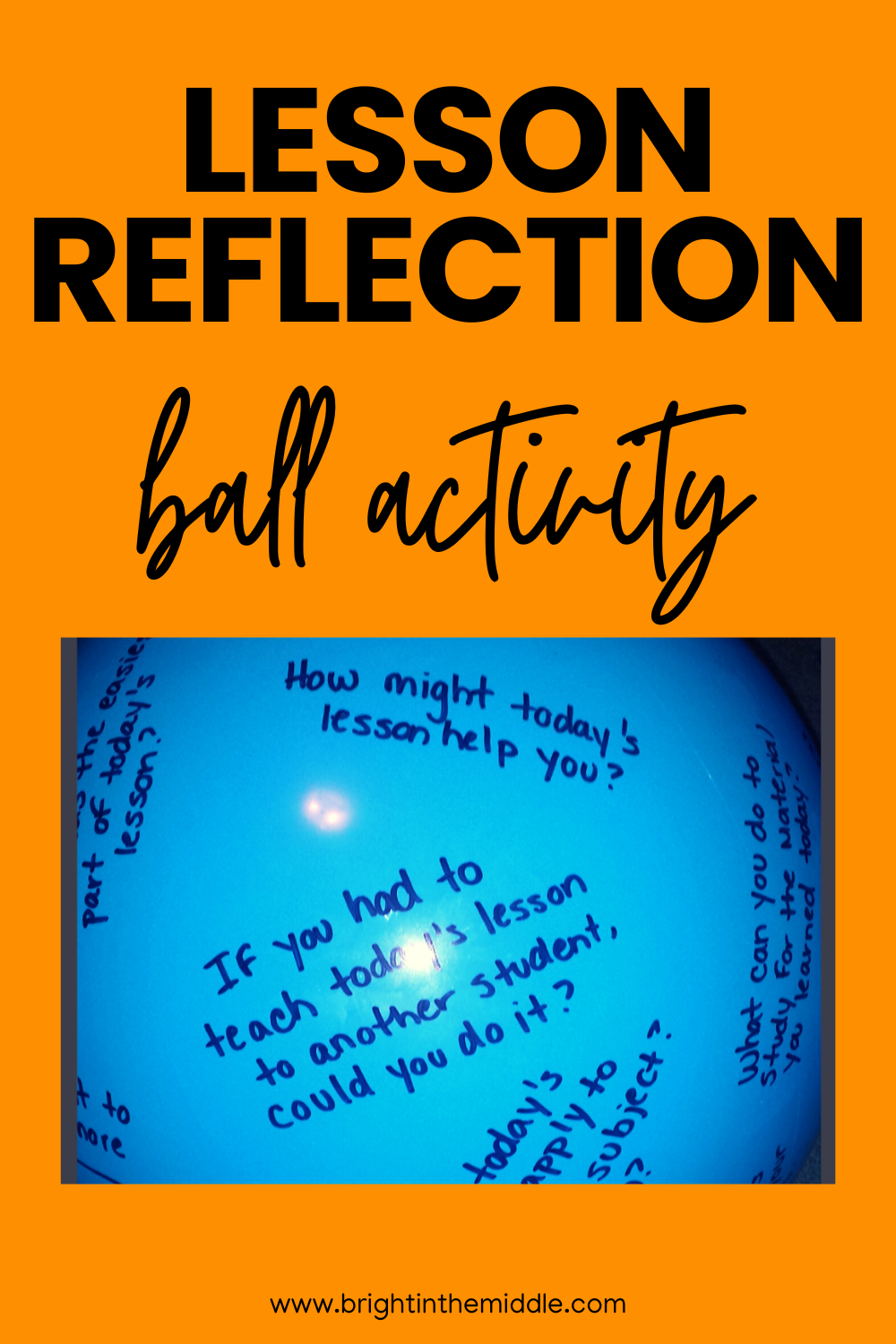
I would take this ball at the end of class and ask who wanted to catch it. It was pretty much everyone. I’d call on a student and throw the ball. I then directed the student to read and answer the question that their right thumb was closest to. This was a truly awesome addition to my classroom. It helped make every minute count, and I was able to get my students engaged in formative assessment.
#2 Formative Assessment Strategy – Closures for Lesson Plans
I’m not going to lie, the reflection ball has saved my life so many times when my lesson was cut short. I mean, it happens. Sometimes there are classes that are longer than others and the students work faster. However, just like many things, some activities just get old and played out. You want to keep your lessons fresh and exciting in order to keep your students engaged. So, once again, to solve this problem, I created lesson closure cards to add to my teacher toolbox for formative assessment strategies. The set includes fifty closure cards that I laminated and connected with a ring clip to have handy during lesson planning and to be referenced in a pinch.

What are some assessment strategies? Some ideas for closures that are included in the set are:
Wisdom Whispers: A student will whisper to the person beside them and tell them what they learned from the lesson. That person will whisper the same thing to the person beside them and so on. Have the person at the end say it out loud and see if it’s the same.
Snowball Fight (one of my all-time favorites!): Students will write a question, related to the lesson, on a piece of paper. Students will ball them up, throw them across the room, and pick a random paper up. The teacher will call on students to answer the question that they picked up.
Make a Simile: Students will create a simile dealing with the lesson. Example: The layers of the atmosphere are like the layers in a hamburger.
Footprints: The students will draw a footprint (or are given a picture) and will write down things from the lesson that they will “walk away with”.
If you are interested in adding closure cards to your teacher toolbox, check them out! You can also find them on TPT.
In addition, task cards could be used as a formative assessment. Learn how you can use task cards to make your classroom awesome here.
Now, go out there and rock your formative assessment strategies in your classroom! Your students will love you for it!
Bring the WOW Factor to Your Science Classroom. Click below to learn more!

[…] There are so many games that you can buy that align to the curriculum, and I do suggest that you check them out; however, there are many games that you can come up with on the fly to engage students in the content, especially review games like all around the world, trashketball, and Kahoot!. You can also play games with formative assessment strategies. […]