

Ever wonder what to do with those beautiful poinsettia plants that you have left after Christmas? Why not bring them to the classroom and make some poinsettia pH paper? This is a fun holiday experiment!
Did you know that you can make pH paper using the leaves of a poinsettia plant? You can do this to explore the different pHs of a variety of liquids!
You’ll need:
- poinsettia leaves
- spoon
- pot
- burner
- bowl
- strainer
- water for “cooking” poinsettia leaves
- cups for different liquids
- liquids: orange juice, hydrogen peroxide, water, milk, baking soda solution (baking soda and water), and more if you wish! These are easy, but you could also use coffee, a borax solution, vinegar, bleach, or any other substance. You can also just do 2-3 to keep the experiment simple!
Steps to Make Poinsettia pH Paper
1. Take the poinsettia leaves and chop them into very fine pieces. You’ll be steeping them like tea.
2. Place the pieces into the pot.
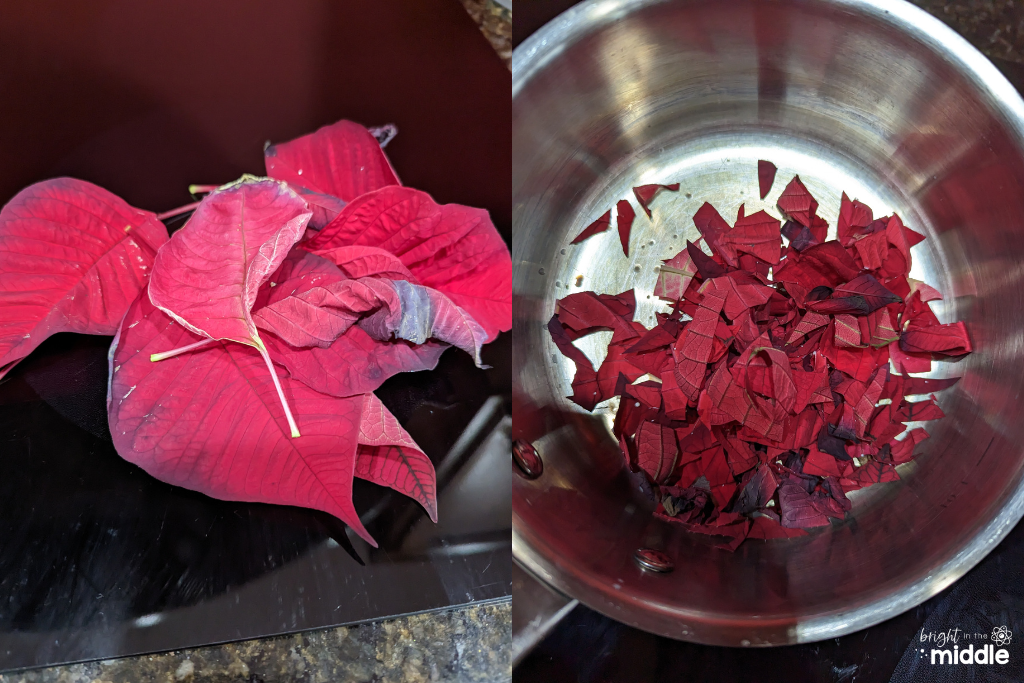
3. Pour water into the pot with leaves. Just cover them. It should possibly be around 1-2 inches.
4. Let the water and poinsettia leaves boil for about 5 minutes. Turn the burner off (You can also use the microwave!). The goal is to make sure the leaves are losing color, and the liquid is red.
5. Get the strainer and the bowl. Pour the leaves mixture through the strainer. You will see a pink-purplish liquid in the bowl.

6. Submerge and soak one to two coffee filters in the poinsettia extract. Once the water is cool enough, you can take the filters out and set them to dry. This could take an hour or two.
7. Once the paper is dry, cut them into strips to use as pH testing strips. These are homemade litmus strips! Litmus paper is used to test the pH of a given substance.

8. You will need as many strips as liquids you have.
9. You can dip the strip into the liquid about halfway. You’ll do this for each liquid. You can also use a dropper to place the liquid on the strip.
10. Observe and record your results.


If you want to do this in groups, you’ll need enough liquids and testing strips for each group!
Why Does This Work?
Why does this liquid serve as a good pH indicator? Poinsettias have natural pigments called anthocyanins. It’s what gives the leaves their red color. This pigment can act has a pH indicator because if it’s exposed to substances with different pH’s, the color changes. If it is more acidic, it will appear more red. If it’s more alkaline, they will appear more green.
For the test strips, if the liquid has a pH less than 3, the strip will turn bright pink. If the pH of the liquid is 3-4, the strip does not really change. There will not be a lot of color. If the pH is 4-7, the strip will turn a blueish color. If the pH is around 7, the strip will be a blueish-green. If the pH is greater than 8, the strip will turn into a yellow-green color.
- If you don’t have the means to create the strips in the classroom, you can always create them at home and set up a pH experiment in your classroom. There are some videos online that you can share with your students!
Here are some helpful videos for making poinsettia pH paper for the visual learners!
How to Make pH paper from Poinsettias
Making a pH indicator from Poinsettia leaves
This is a great hands-on, holiday-themed way to explore the principles of pH and pH indicators using natural materials!
[…] Is it Christmas time? You could also explore making poinsettia pH paper! […]