

Learning about the human ear parts is essential knowledge because it helps us to understand how sound waves can travel from outside of our body to our brain to help us comprehend what is going on around us.
It’s also important to know the human ear anatomy because, if something is not right, it’s easier to understand and potentially know how to fix it.
The human ear is divided into how many parts? In this post, I will share some WOW Factor ideas of how you can help your students to learn the human ear and its parts and their connection with sound waves.
First, I will share some WONDER strategies. These are the activities that you’ll use to introduce your students to the human ear parts and get them internally motivated to learn more about the topic. Second, I will share an interactive lesson about the human ear parts and functions to reduce student overwhelm and help them to remember the material. Finally, I will share some WIDEN strategies that your students will love, and it will help them to extend their knowledge of this topic!
Let’s dive in!
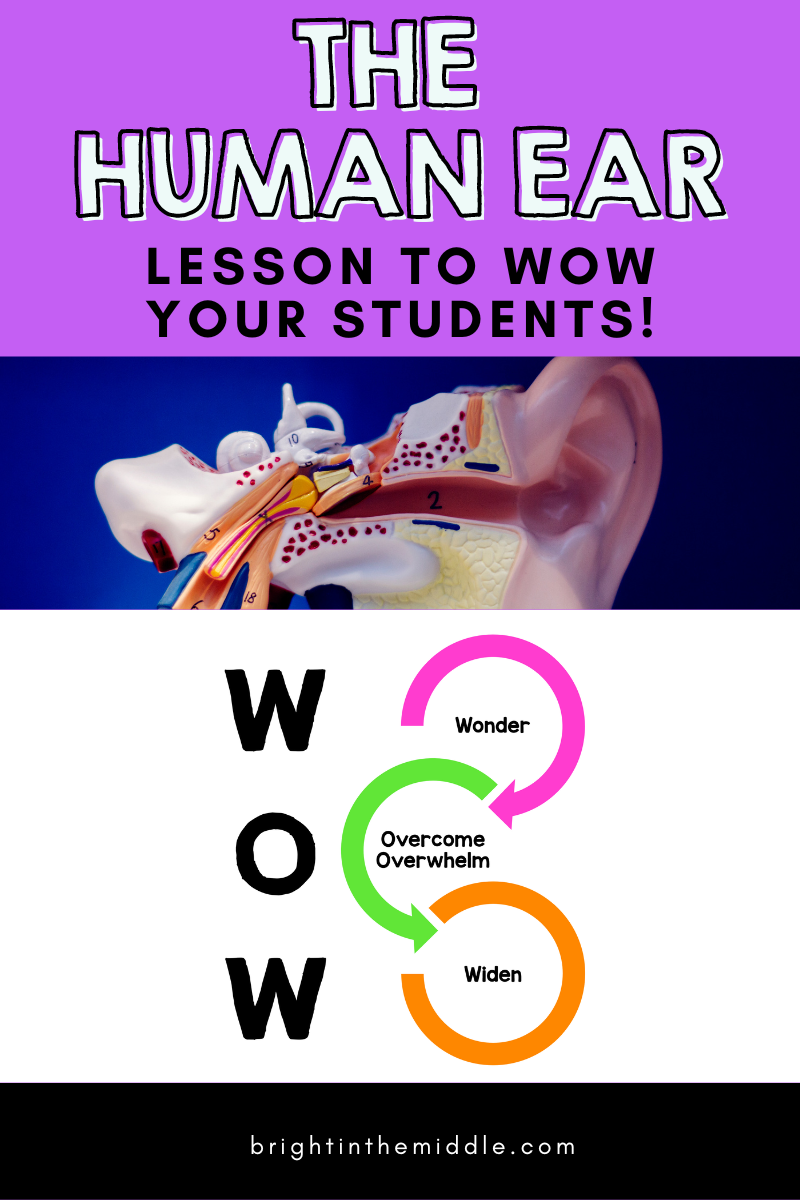
WONDER Strategies for Teaching The Human Ear Parts
I love to use WONDER strategies to help students become intrinsically motivated to learn a topic. These activities are designed to introduce a topic to a student, but keep them wanting to learn more. Here are 3 ideas that you can use before teaching about the human ear to your middle school students.
Parts of the Ear Puzzle
This is one of my favorite things that you can do before learning about the human ear. This take some prep work, but it’s good to get students’ minds going!
You’ll need to print out a picture of the human ear, something like this one here. Once printed, you’ll need to cut out different parts of the ear. For example, cut out the eardrum, the hammer, the Eustachian tube, etc.!
You’ll need to make enough of the puzzles for the number of groups/partners you plan to have completing them.
Then, task your students to put these pieces together in the order that they go in the ear!
From there, you can check their answers, have them work with other groups, and see if they can get it as close to perfect as they can.
They are going to want to know the answers. You can tell them, or wait until they complete the lesson to find out! They should definitely be curious by the end of it! The human ear diagram they create will be interesting!
I found this cute little one on TPT that may be helpful!
Audiologist Visit
There are a lot of professional people that are willing to come to your classroom, whether in person or virtually, to share their knowledge with your students.
A good guest speaker to have before learning about the human ear parts and the relationship with sound waves is an audiologist in your area. If you don’t have one, you can look for a virtual guest speaker.
You can let the speaker know that your students haven’t yet learned about the parts of the human ear; however, let them know that they can review the parts if they wish, and discuss what they feel is appropriate.
They can share real-life examples of the challenges that some people may face when it comes to their hearing. They can also discuss how technology has helped to improve some people’s experiences!
I’m sure your students will have lots of questions, so be sure to allow for a Q & A time. Be sure to screen questions before asking the guest speaker.

Role Playing Activity
Have your students participate in a skit!
Creating a skit for your students to perform is so much easier these days.
I don’t have one that I can tell you about, but I can tell you how you can get one.
Just go to ChatGPT and type: “Write a script for a role-play activity for the parts of the human ear for middle school students.”, and bam, just like that, you’ll have a script for your students to put on a miniature skit!
The Human Ear and Hearing Interactive Lesson
Interactive lessons are specifically designed to help students remember content by using the 7 steps to help students retain information!
Interactive lessons do this by segmenting the lesson and including activities within that assess student knowledge and help them to process the information.
In plain language, these lessons break things down for the students and help them to “get it” and remember it!
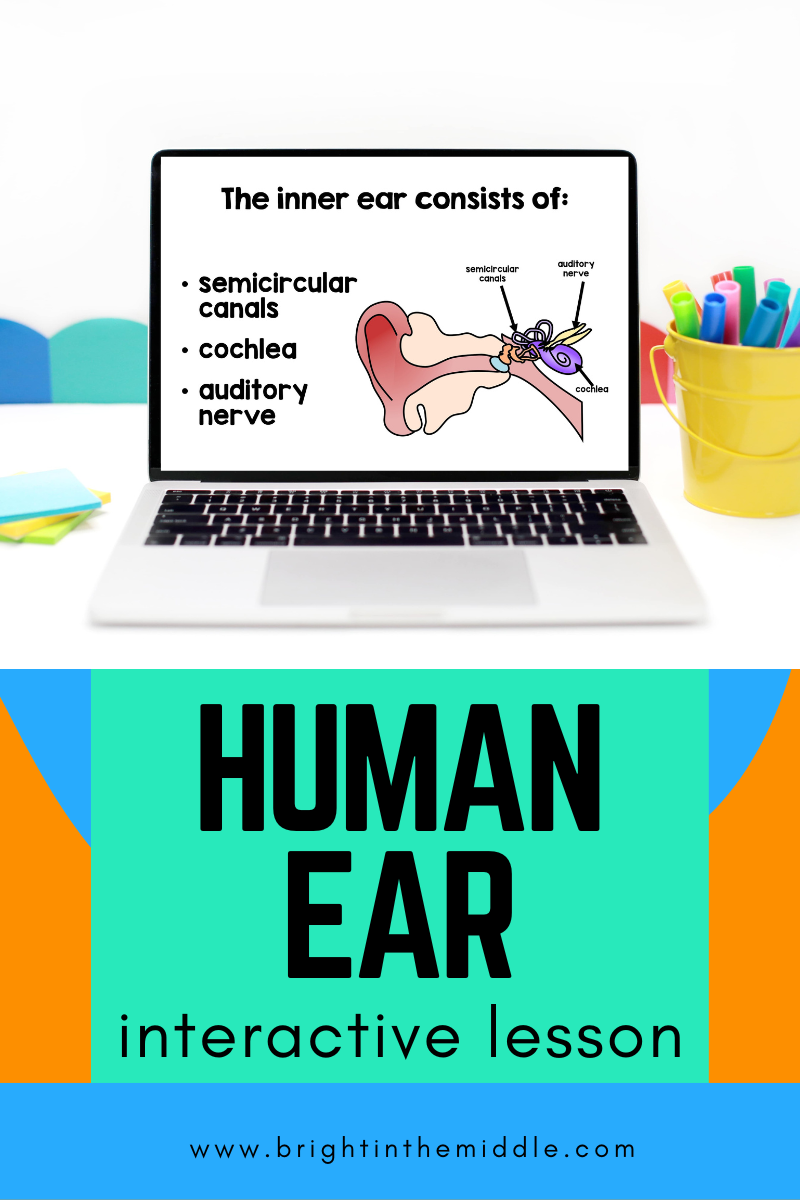
Did you do the ear puzzle? Time to get the human ear labeled! In this Human Ear and Hearing Interactive Lesson, students will learn about the parts of the human ear, the functions of the human ear parts, how sound travels, outer ear, middle ear, and inner ear, common ear problems, and much more!
The embedded activities include labeling a parts of the human ear diagram, typing in the text box questions, an anticipation guide, exploring outside resources, and so much more.
Students truly enjoy these interactive lesson and they learn so much!
You can find this lesson in the Bright in the Middle Shop.
You can also find this in my TPT Shop.
The Human Ear Parts WIDEN Activities
So, at this point, your students have learned a GREAT deal about the human ear, it’s parts and functions, and the connection to sound waves. Have more time? It’s time to do a WIDEN activity. This is where your students can show off what they know, and at the same time, extend their knowledge beyond state standards. It never hurts to learn more as long as students are not overwhelmed.
Here are three WIDEN activities that you can try in your classroom. Skip the human ear worksheet and try these out!
Common Ear Problems Project
You may have some students that this lesson is really personal to them. They may have an issue with their ear and may relate. For some students, they may not really get the parts of the ear or common problems associated with them.
That’s why it’s nice to dive in a little deeper with some of the common ear problems that they could face or know somebody that is facing or may face in the future.
- You can let students work individually, in partners, or in groups.
- Give students the opportunity to choose a common health problem, or you can assign one to them. Some examples include: hearing loss, tinnitus, ear infections, ear barotrauma, and swimmer’s ear.
- Once students have a topic to research, they can search symptoms, prevalence, risk factors, preventions and treatment, and real-life examples.
- After they have their research, they can present their findings in whatever way that you wish. They can give an oral presentation, create a poster, create a slides presentation, role-play, tell a story, etc. The options are endless!
Technology Debate
One of the coolest things about healthcare these days is the technology that has been created to solve a problem.
As you grow older, you realize that not all technology is created equally, and some doctors will recommend one thing, and another doctor will recommend another.
Your students can explore this. There are two common treatments for improving hearing. One is hearing aids, and the other is cochlear implants.
Have your students “pick a side” or they can choose a side to debate.
Let your students have a debate in your classroom (with research and evidence completed) to discuss which one is the better option.
Encourage thoughtful discussions!
Jump Further into Sound Waves
Don’t have time for projects and debates? It’s ok to move on to learning more about sound waves! Maybe you teach sound waves first. Nevertheless, here are some more ideas on teaching sound waves!
I hop you enjoy these human ear structure and function activities!
Help your students master science content!

[…] The Human Ear […]