

Teaching Science Middle School
So, your teaching science in middle school? What do you think? I remember when I first began my teaching career in middle school, I sure did not know what to think.
First of all, I did not know what to think of the students. I loved that age group! Bless them, they don’t know who they are, and you get a different child every day, but that’s what I love. It’s a great age to teach because you can guide them in a positive light to help them find out who they are.
In addition, I had no clue what to do with the content. I mean, I knew a lot of science content. I always did good in school and in all of my science classes throughout high school and college, but when it came to teaching this content in middle school, I did not know where to start.
It was time to, first, find out what exactly what I needed to teach and then figure out how to teach it in an understandable form for my students, which is what pedagogical content knowledge is (PCK). I needed to work on my science PCK. So, once I learned the content, which it was fairly difficult to figure out what exactly my standards were asking for me to teach (more about that later), I needed to know more about HOW to relay this to my students.
Years of schooling and training later, I’ve learned some ways to help students understand and retain their science material, and I’m going to describe one of them in this post. Are you ready?
Teaching Science Strategies – One Easy Tip
Once you know what content to teach to your students, one of the most crucial things that you can do to help students know what is important to learn and help them retain it is to direct students to important information.
It is essential to highlight the most important information you want your students to understand.
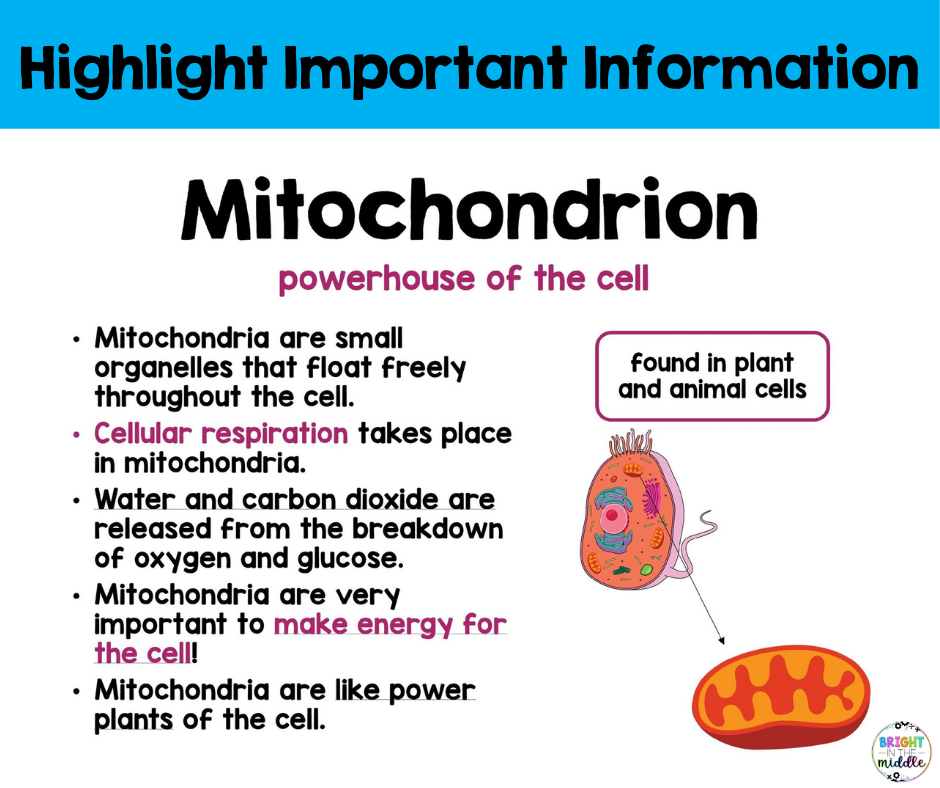
For example, middle school students need to be aware that the mitochondria are the powerhouse of the cell and make energy for the cell. It must stand out!
Whether you are teaching science online or in person, you can easily implement this strategy into your classroom.
Going back to the mitochondria example, in your lesson, such as PPT or video, however you deliver your lesson, you can highlight, underline, color, or create a larger font for this important concept in your lesson. In the photo below, the essential information is changed to a different color to stand out.
Other ideas to make this information known is to verbally repeat important information out loud, circle it, point arrows in the direction of the information, or add an animation to it (as long as the animation is not distracting).
Science Resources are Lacking – What to do?
So, maybe you know what strategies for teaching science are essential to help your students retain information, but you don’t know where to find the appropriate content for middle school and what exactly is important to highlight. That was one of my concerns when I began teaching.
Once I entered the classroom, they were pretty much like, here’s your standards and a really old, outdated textbook. Have fun!
One thing that I knew was that the textbook, at least, would have content in it that was appropriate for middle school. Middle school is that sweet spot. The science content isn’t super easy like elementary school, but it’s not as complex as high school.
Although this old textbook was helpful, it was old, and not the only resource that I needed.
Here are some things that I used to find out WHAT was important and what was the most essential information that my students needed to learn.
- Textbook: Although old, there is important information.
- Standards: In my state, some unpacking standards elaborate a bit on what needed to be highlighted.
- Blogs: There are a lot of blog posts that teachers in the classroom post about ideas for teaching certain topics.
- YouTube videos: Most of the time, you can type in a certain concept, like the atmosphere, followed by “for middle school” and videos will pop up that will be helpful.
- Books: One of my favorite books to get content from is Everything You Need to Ace Science in One Big Fat Notebook.
- Teaching Resources: In addition to blogs, many teachers sell resources online that are already created with the important information highlighted!
- Colleagues: If you have someone in your content area on your grade level, you are lucky. They are a wonderful resource to help you learn what’s important for your students to know.
- Released test questions: These will give you a great idea of what is expected for students to learn.
Once students determine what the most important information is, they can continue to build upon it with hands-on activities and enrichment opportunities.
More Resources for Teaching Science Effectively
Want to learn more about teaching science methods? Check out these tools for teaching science!
Mayer’s 12 Principles of Multimedia Learning
7 Steps to Help Your Students Retain Information Like a Rockstar
To learn more about writing your own teacher blog post, check these 7 Helpful Tips on How to Blog Like a Boss!
You don’t want to miss these awesome science teaching tips!:
3 Huge Reasons CER in Science is Important to Students
The Next Generation Science Standards Crosscutting Concepts and 6 Easy Ways to Use Them
[…] Teaching Science Middle School […]