

Are you about to teach about single-celled organisms in your classroom? I have some ideas for you that I think your students will love and will bring the WOW Factor to your classroom! Aren’t single-celled organisms so neat? They are just the cutest (most of the time) living things that just live their own little lives while we are oblivious to it, worrying about our own.
Based on experience, most of the middle school students that I have taught have never seen or have even been introduced to these unicellular organisms, yet they are EVERYWHERE.
In this post, I will share some tried-and-true activities that I, and others, have used with their students and have been a HIT in bringing the WOW Factor. First, I will share some introductory activities that you can try with your students to get them engaged in learning about these little creatures and begin to wonder more. Second, I will share an interactive lesson that you can use with your students that provides a lot of value and information while reducing student information overload. Finally, I will share some widen activities that have been used before to let your students’ light shine and share what they have learned!
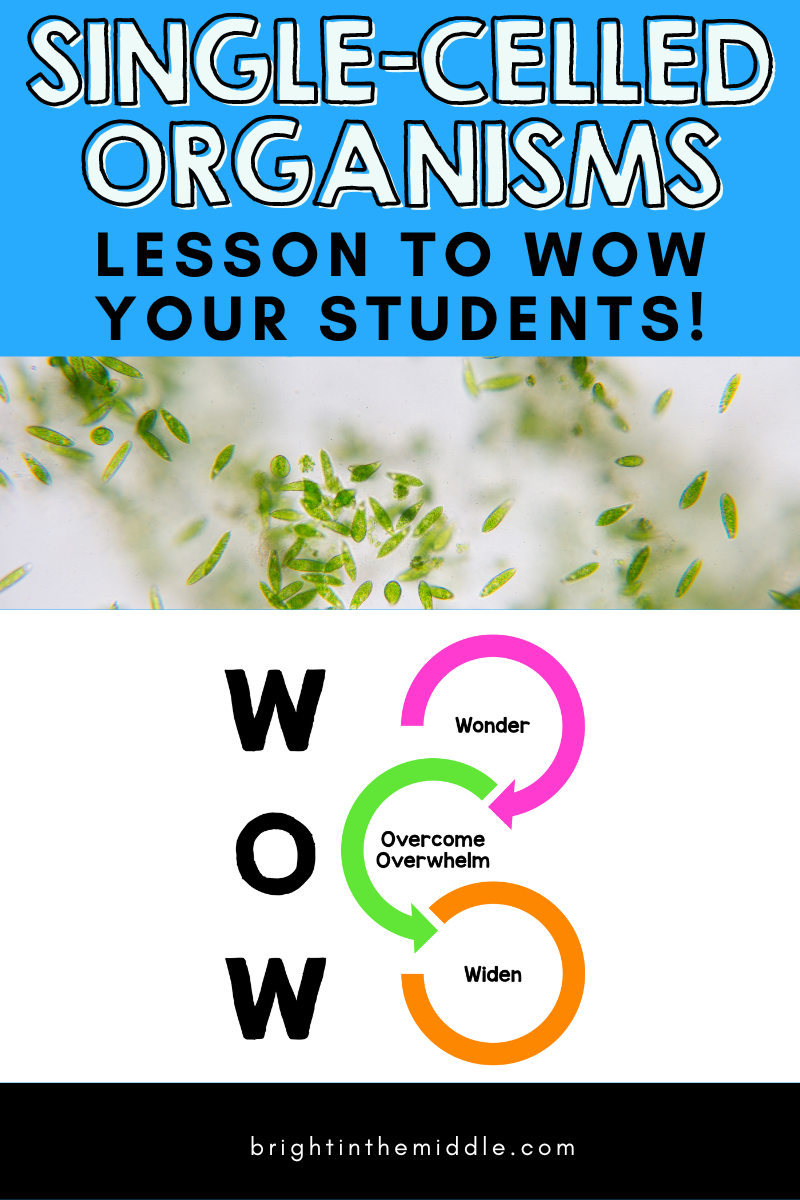
Single-Celled Organisms Introductory Activities
There are many ways to get your students excited about learning about unicellular organisms, but I have two favorites that I would like to share with you in this post. You can choose to do both of these things with your students, or just choose one. It all depends on the time you have (I know…there is never enough!).
Look at Pond Water
If you have microscopes at your school, this is a MUST. There are so many things to learn about just from looking at a drop of pond water. Don’t have a local pond? Find a nice mud puddle! As I’m writing this, it has rained for 3 days straight. I know I could find some nice single-celled organisms now!
Set up microscopes. Put your students in groups and have one student prepare a microscope slide with one drop of pond water.
Have students to just explore. Can they find anything? What did they find? What are their observations?
From my experience, you never know what may show up! It’s so much fun!
Concentric Circles Discussion – What Makes Something Living?
Depending on when you teach this lesson, you may or may not have just taught about what makes something living vs non-living. This is your opportunity to engage students and see what they remember.
The goal is to answer the questions: What makes something living? Can something that is one cell be a living organism?
There are many ways to spark discussion, but one neat idea is to do concentric circles.
- Have your students to form circles, one on the inside and one on the outside.
- Each student will pair with another student (inside circle and outside circle).
- Give them a question to discuss with their partner. Give them a set amount of time.
- Let them know that each student should both share and listen.
- You can have students to shift to the left or right in order to change partners!
In the end, as a class, discuss some of the main points they talked about.
Single-Celled Organisms Lesson to Overcome Overwhelm
Now that students are geared up for some deeper content and vocabulary, it’s time to dive into the interactive lesson. Interactive lessons are specifically designed with student information overload in mind. When students receive too much information at a time, they have too much cognitive load.
These lessons are designed to reduce cognitive load by chunking information and giving students a chance to process it. In addition, there are other researched-based strategies.
What does single-celled organism mean? How do single-celled organisms reproduce? What do single-celled organisms do? What do single-celled organisms eat? How do single-celled organisms move?
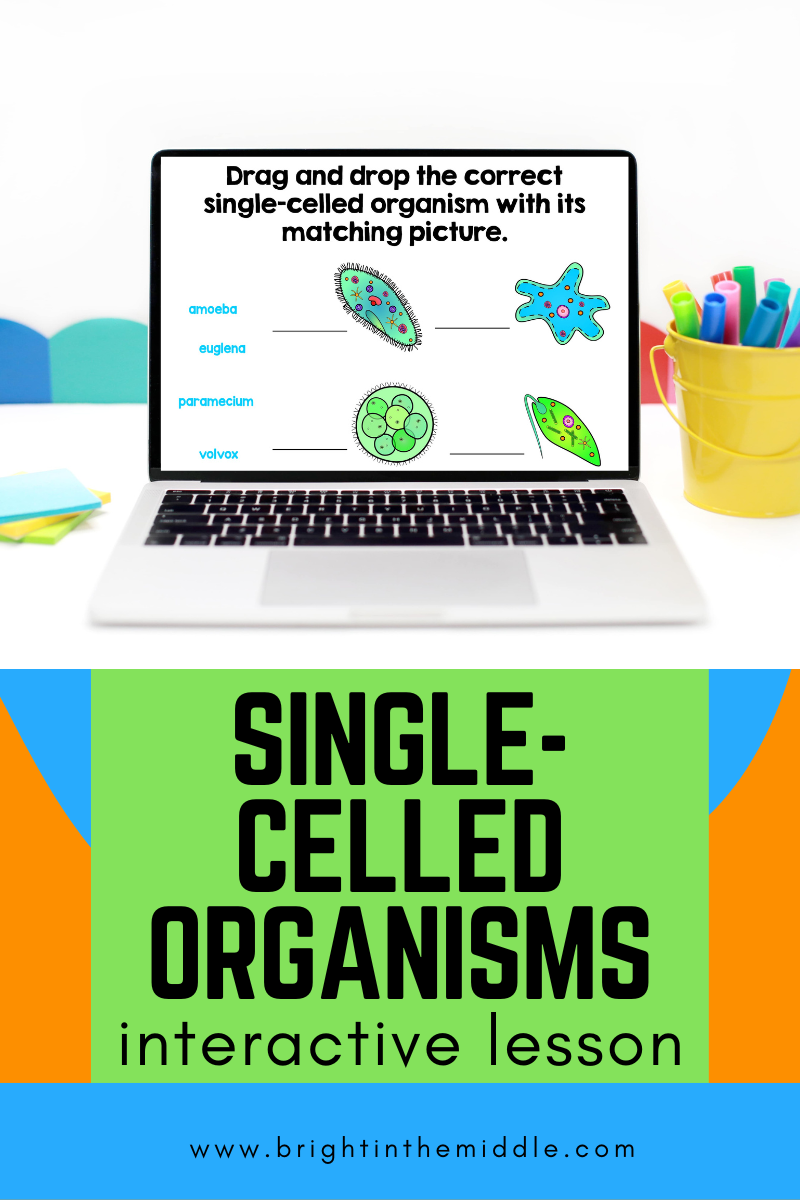
Time for students to learn!
This particular interactive lesson about single organisms dives deep into four special unicellular organisms: amoeba, paramecium, euglena, and volvox. It covers the single-celled organisms definition, examples of unicellular organisms, structures and functions of these organisms, prokaryotes vs eukaryotes, single-celled organism vs multicellular, and so much more!
Some of the embedded researched-based activities include a pre-assessment, exploring outside resources, drag-and-drop activities, graphic organizers, and more!
You can find this in the shop.
You can also find this on TPT.
Examples of Single-Celled Organisms WIDEN Activities
Cartoon
This is one of my favorite activities to do when teaching about singled-celled organisms, and it’s FREE in the shop!
Students can create their own unicellular cartoon to show off a piece of information they learned about one or more of the organisms.
My students have been SO creative with this single-celled organism drawing, and I know yours will too. This is really great for the artistic students to shine.
Students should create a cartoon that reflects the characteristics of single-celled organisms.
Students can be graded on attractiveness, coloring, required items, grammar, and effort.
A rubric is included. You can learn more here!
You can also find this on TPT.
Task Cards
Another one of my favorite things to with his topic are these Unicellular Organisms Task Cards! There are so many fun ways to use task cards, including around the room style, centers, and partner games.
I love the good old around the room. I tape these all around the room and give students a chance to walk around to answer the questions. There is a definitely a time to sit down and work, but there is also a time to get up and move!
These task cards cover all of the things covered in the Single-Cell Organisms Interactive Lesson. This is just another way to assess students knowledge on the topic.
Bonus – National Donut Day
I have a bonus activity for you! National Donut Day occurs on the first Friday of June each year! Who doesn’t love to celebrate National Donut Day?
This is a great activity for the end-of-year, and of course, it’s fun to eat donuts! Last year, I bought the little snack donut sticks that are package and students loved them.
What does National Donut Day have to do with single-celled organisms?
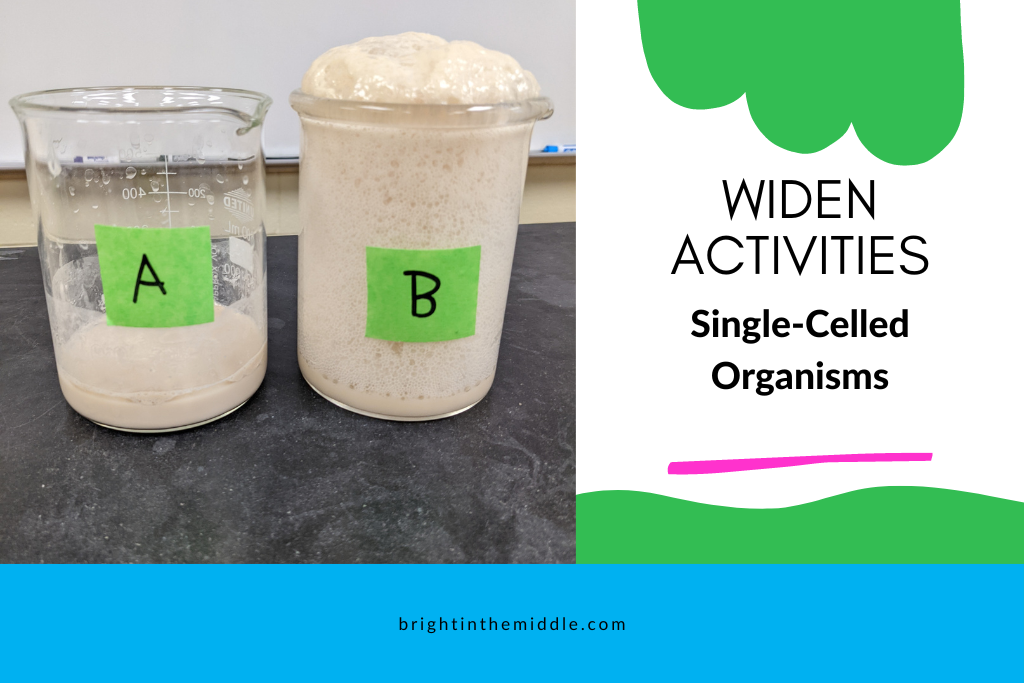
Well, some donuts are yeast donuts, and yeast is a unicellular fungus! In this National Donut Day activity, students learn all about this special day, the difference between cake and yeast donuts, and what makes yeast a living organism.
You can read more about it here.
Help your students master science content!

[…] Single-Celled Organisms […]