

What do your students think when they hear “energy flow in ecosystems”? Do they think of energy like electrical energy, or do they think about the chemical energy we get from what we eat? Well, why don’t you ask them? You may get the dreaded sigh when you tell them that you are going to start the ecosystems unit, but it doesn’t have to be that way.
In fact, ecosystems are very exciting! We are a part of an ecosystem! Our body is an ecosystem. There are so many fascinating and exciting things to learn about ecosystems and what part we play in the whole situation. How does energy flow in ecosystems? Help your students find out!
Time for the WOW Factor! In this post, I’m going to give you some ideas to take to your classroom to hype your students up and get them wondering and excited about learning everything there is to know about energy flow through ecosystems. Then, I’m going to share a lesson that you can use that will help your students retain information using the 7 steps to help students overcome overwhelm. Finally, I will share some activities that your students can do to widen their knowledge on where energy flows in ecosystems.
Energy Flow in Ecosystems – WONDER Strategies
So, what does it mean for students to wonder? It is the INTERNAL motivation to learn more about a topic. That’s the goal of the WOW factor lesson strategies. I have some ideas for you that you can bring to your classroom to hype them up about this topic. You can choose to do just one or multiple!
Ecosystem in a Bottle
This is a great activity to do after you learn about ecosystems, but it’s also great to do BEFORE your students learn as well! What better way to ask your students, “How does energy flow through an ecosystem?” when you have ecosystems in a bottle lying in your classroom!
When you do activities such as this beforehand, students have a visual representation that they can refer to. Of course, you can talk about the ecosystem right outside your window, the ocean’s ecosystems, and other ecosystems, but having something small and tangible makes the concepts a lot easier to manage.
If you look on the internet, you can find a ton of resources on making an ecosystem in a bottle.
You will need:
- an empty 2-liter bottle
- soil
- seeds
- water
- string
- scissors
- marker
- earthworms
To save you some reading time, I’ll just attach some helpful videos for you!
These do not mention the worms, but they will be an awesome addition as a consumer in the ecosystem.
Abiotic and Biotic Factors Scavenger Hunt
One of the big ideas when learning about ecosystems is how abiotic and biotic factors interact with one another. It’s important that your students are familiar with these terms before learning about energy flow. One of the most important part of food chains, food webs, and ecological pyramids is that the Sun (abiotic factor) provides energy for producers (biotic factor).
So, what better way to get them excited than to go on a scavenger hunt!
- Take your students outside and give them the task to find 5 biotic factors and 5 abiotic factors. If you have an iPad or cell phones, they can take pictures of these items.
- Your students can work individually or in groups!
- Make it a competition! Whoever finds the most correctly labeled abiotic and biotic factors in the class wins a prize!
- Once inside, have a discussion about how these factors interact.
Starburst Ecosystem Activity
Another important concept dealing with energy flow in ecosystems is how the energy decreases in each trophic level.
Once again, this activity can be completed at the end of the lesson, but it’s great as an introduction as well.
You will need
- lots of starburst
- Attachments on this website
Read through this activity. Students will ultimately learn how energy is lost through the trophic levels.
It’s a great way to demonstrate the flow of energy in ecosystems.
Any activity with food is great!
Teaching Ecosystem Energy Flow – OVERCOMING OVERWHELM
Now that your students are hyped up about energy flow in ecosystems, it’s time to dive deeper into the content to learn how to model energy flow with food chains, food webs, and ecological pyramids.
You can help your students overcome the overwhelm of information by using different strategies to reduce cognitive load. Interactive lessons do just that, these strategies are embedded into the lesson to help students retain content!
This particular flow of energy in ecosystems interactive lesson is broken into chunks so that students can process pieces of information at a time before moving on.
Which energy flow in ecosystems ideas will you choose?
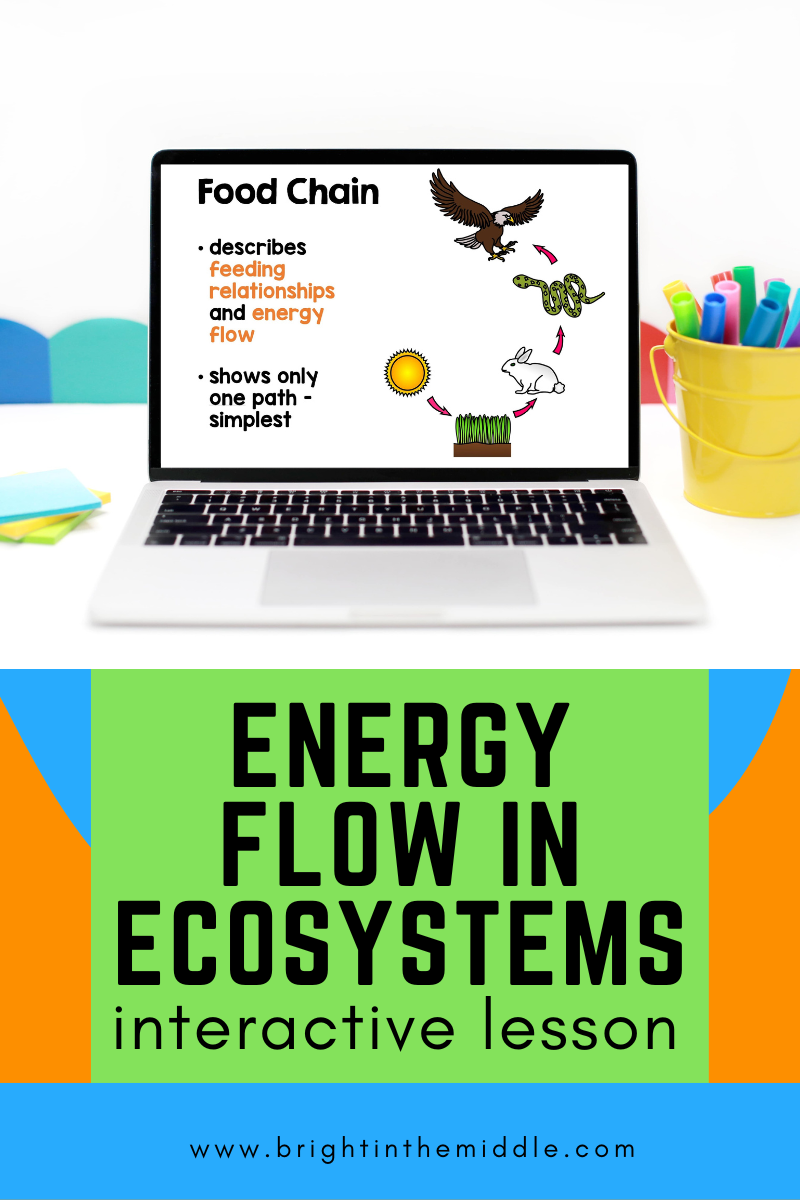
It covers photosynthesis and cellular respiration, producers and consumers, trophic levels, how energy is lost in each trophic level, source, producer, primary consumer, secondary consumer, tertiary consumer, and more!
In addition to the lesson information, there are interactive activities embedded and these include an anticipation guide, vocabulary matching , exploring outside resources, create your own energy flow ecosystem diagram, and more!
This is not your average energy flow in ecosystems ppt. It is so much more!
You can also find this lesson on TPT.
Energy Flow in Ecosystems Activity Ideas – WIDEN Strategies
Lion King
Ok, this may be a stretch for watching after just teaching energy flow; however, it’s a GREAT thing to do after covering all of the ecosystem unit! You can discuss limiting factors, organism relationships, and so much more!
Any excuse to watch an awesome movie in class, right?
You can still have your students to do the following during or after the movie:
- name abiotic and biotic factors
- names different biomes
- draw a food chain from the living things in the movie and label trophic levels
- identify decomposers, producers, and consumers
- identify herbivores, carnivores, and omnivores
There are a lot of awesome things to cover!
Create Class Food Web or Food Pyramid
This is a fun team effort and would be an awesome hallway display. So, what do you do? As the teacher or as a class pick an ecosystem you want to “be”. For example, your class could be an ocean ecosystem.
Each of your students will have the opportunity to pick a living organism that they want to be in that particular ocean ecosystem. You can give them choices or have them to pick cards.
Once they have their organism, there job is to research it, learn about its place in the ecosystem and food chain, learn what eats it and what it eats, and then draw a picture of it.
Once the whole class is finished, students will conversate with each other to determine which organisms eat who create a CLASS FOOD WEB!
Display their creation in the hallways. You can use yarn to represent relationships!
They can learn a lot about the energy flow in ocean ecosystems others with this activity.
Group Ecological Pyramids
In groups, students can create ecological pyramids of an ecosystem that’s close to home. What kind of ecosystem do students live in?
Have them to research their own backyard. See what students come up with! What fun to apply the information to your own life, right! This is a great energy flow through ecosystems activity!
Help your students master science content!

[…] Energy Flow in Ecosystems […]