

Are you teaching the properties of waves and looking for ideas to WOW your students? The characteristics of waves is one of the first things you teach in your waves unit, along with the types of waves. Knowing the properties of waves can help students understand things such as wave behaviors, visible light waves, sound waves, and more!
What are the four basic properties of waves? They are amplitude, wavelength, frequency, and wave speed.
Especially when you are introducing a topic, you want to make sure you really engage your students in the topic. You want them to WANT to learn. This makes the rest of the unit so much easier to get through!
In this post, I will give you some WONDER strategies to use to introduce your students to the properties of waves and help them to become intrinsically motivated to learn more about the topic. Second, I will share an interactive lesson that will allow students to learn about the 4 properties of waves in an engaging way. Finally, I will share some WIDEN wave activities to help students learn even more about these properties and expand their knowledge.

The Properties of a Wave Introductory Activities
I’m a firm believer in getting your students excited about a topic before just diving into it. Here are 2 wave activities that you can do to hype your students up about this topic.
Exploring Waves Stations
Your students may already have ideas about mechanical waves and electromagnetic waves, but now it’s time to explore some of the properties.
This station activity should consist of observations, and you can also have your students to do some exploring.
You can let your students know what the properties of a wave are. As they go through the stations give them the following guides.
- Observe and record observations.
- Explore and record data.
Here are the stations:
- Slinky Station – Have students to explore different waves they create by shaking the slinky at different frequencies and amplitudes.
- Water and Ping-Pong Ball Station: Get a clear tray of water. It doesn’t have to be large. Fill the bottom with a little bit of water. Have students drop a ping-pong ball from various distances to observe the waves. This can get messy, so have some paper towels on hand!
- Tuning Fork Station – Give students a tuning fork, metal spoon (or reflex hammer), and a cup of water. Have them to strike the tuning fork with the spoon above the cup of water and then slowly place it in the water. Have them explore with different intensities and heights.
- Rope station: Similar to the slinky station, have students to explore different waves by trying to create waves with different frequencies and amplitudes.
As students are completing these stations, walk around and see what they are discovering!
Prior Knowledge Art
Don’t have time for stations? I feel you!
Instead, you can do a quick activity to get students wondering. This will help activate their prior knowledge.
This is what you can do:
- Give each student a piece of plain white paper.
- Tell them to draw a wave. You can give them 1 minute.
- Have them to compare their drawings with a partner or their group.
- Then, tell them the properties of waves.
- Give them another chance to draw a wave on the other side.
- Does it look different? Why or why not?
Now it’s time to dive into the lesson. What are the properties of waves?
The Properties of Waves Interactive Lesson
Once your students are wondering about waves and their properties, it’s time to dive into the vocabulary and the content.
For this, I suggest an interactive lesson! Interactive lessons are designed with the student in mind. It helps to reduce their cognitive load. What’s that? It’s the amount of information they can take in at a time.
These lessons reduce cognitive load by using the 7 steps to help students retain information. These include things like highlighting important information, chunking information, and starting simple.
These lessons teach the content with embedded activities to help students process information. This is a great avenue for students to take their properties of waves notes.
Interactive lessons work well in flipped classrooms.

In this properties of waves lesson, students will learn about the properties of waves, review waves, mechanical and electromagnetic waves, crest and trough, compression and rarefaction, the relationship between frequency and wavelength, and so much more.
The embedded activities include answering in the text box, drag-and-drop practice, an anticipation guide, exploring wave simulation, and more!
It’s like a properties of waves PowerPoint, but so much more! Skip the properties of waves worksheet and try this!
You can purchase this in the Bright in the Middle Shop.
You can also purchase this on TPT.
The Properties of Waves WIDEN Activities
If you want to take your content a little further and allow your students to explore the concepts more, WIDEN activities the way to go! Here are two widen activities that you can try in your classroom.
Build a Wave Machine
One of the things that you can do is build a wave machine! You’ll just need candy or playdoh, skewers, and duct tape.
You can create one as a class, or you can have students work on their own. They will be able to explain the properties of waves with this visual representation.
Here are some resources to help you with this activity!
PhET Simulation
You can also have students to explore this PhET simulation called Wave on a String. This is a great properties of waves lab if you’d like to do it virtually.
I like it on manual. You can have your students explore a variety of things.
- What can you adjust on the simulation?
- What happens when you change the amplitude?
- What happens when you change the frequency?
- See if they can create certain shapes.
- Can you explain how the phase of a wave changes as it travels along a string?
- Describe the properties of waves.
You can even create a waves properties worksheet to go with it!
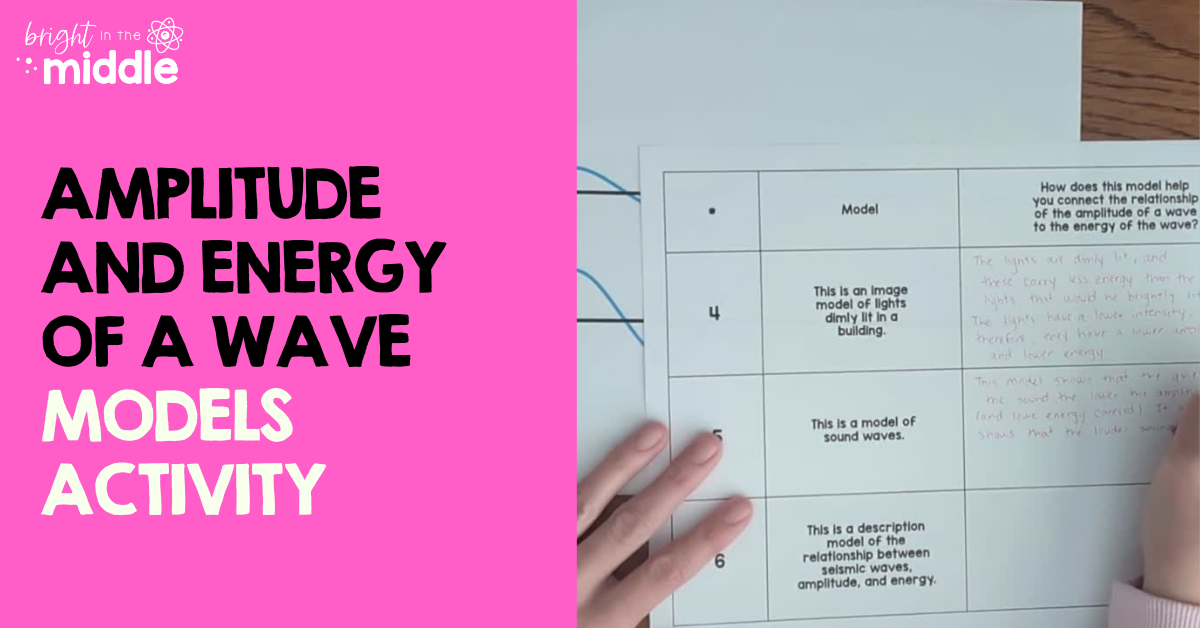
Bonus: Amplitude and Energy of a Wave – Models Activity
One thing that students need to understand is the relationship between the amplitude and energy of a wave. The higher to amplitude, the more energy the wave is carrying.
In this activity, students explore models of seismic waves, light waves, and sound waves to gain a better understanding of this relationship, and more!
Help your students master science content!

[…] The Properties of Waves […]