
Are you using mathematics and computational thinking in your science classroom? Are you looking to include more science and engineering practices (SEPs) in your middle school science classroom? In the past few posts, I’ve shared about different SEPs, and in this post, I’ll share about SEP #5 (Science and Engineering Practice 5) “using mathematics and computational thinking”.
This SEP is aimed for students to use mathematics and computational thinking to represent problems or solve problems. This can be used in tasks such as statistically analyzing data or constructing simulations.
Let’s take a deep dive!

Math and Science Together – Really?!
Ok, let’s be honest, at the middle school level, students absolutely HATE to do math inside science class, but it’s time to start changing their mindset early, because, honey, it’s not going anywhere. Everything is connected! It’s very important!
I think that schools and curricula are working towards interdisciplinary learning to be the norm, but there is still work to be done.
Students may appreciate the other part of this SEP – computational thinking. This is using computers to make some calculations for us!
Mathematics and Computational Thinking in Middle School
As with most SEPs, they overlap with others. Using mathematics and computational thinking is highly connected with SEP #4, Analyzing and Interpreting Data, as well as many more (probably all of them!)
In elementary school, students do use mathematical concepts and techniques. They are using tools such as protractors, thermometers, and rulers to make measurements. They are also collecting data. They should also be able to organize simple data sets. In addition, elementary students use words to represent formulas and ideas when they will eventually progress to using formulas with symbols.
In middle school, they progress to using the mathematical representations of the formulas and use mathematical processes to help answer questions and solve problems (ratios, percents, simple algebra, etc.). Along with mathematics, students in middle school should learn to use computers and other digital tools to analyze large sets of data as well as to solve problems and test solutions with designs.
3 Strategies for Using Mathematics and Computational Thinking in Your Classroom
Use Mathematical Formulas
This is a given, and it’s pretty much a requirement for the majority of topics in middle school science, especially in physical science.
What does this look like?
Here are just a few formulas students will need to use to solve scientific problems.
- speed = distance/time
- acceleration = change in velocity/time
- power = work/time
- density = mass/volume
- mechanical advantage = output force/ input force
- gravitational potential energy = mass x gravity x height
- wave’s speed = frequency x wavelength
- Punnett square percentage calculation
This is just scratching the surface of mathematical formulas in middle school science. If you teach this, you are already rocking this science and engineering practice!
Create Graphs and Charts to Visually Represent Data
Check out this post that talks all about analyzing and interpreting data in middle school. It discusses how middle school students should begin to create their own graphs and charts based on data. There can be some scaffolding in the beginning, but middle school students should be able to decipher what graph/chart type is best used for the data they are analyzing.
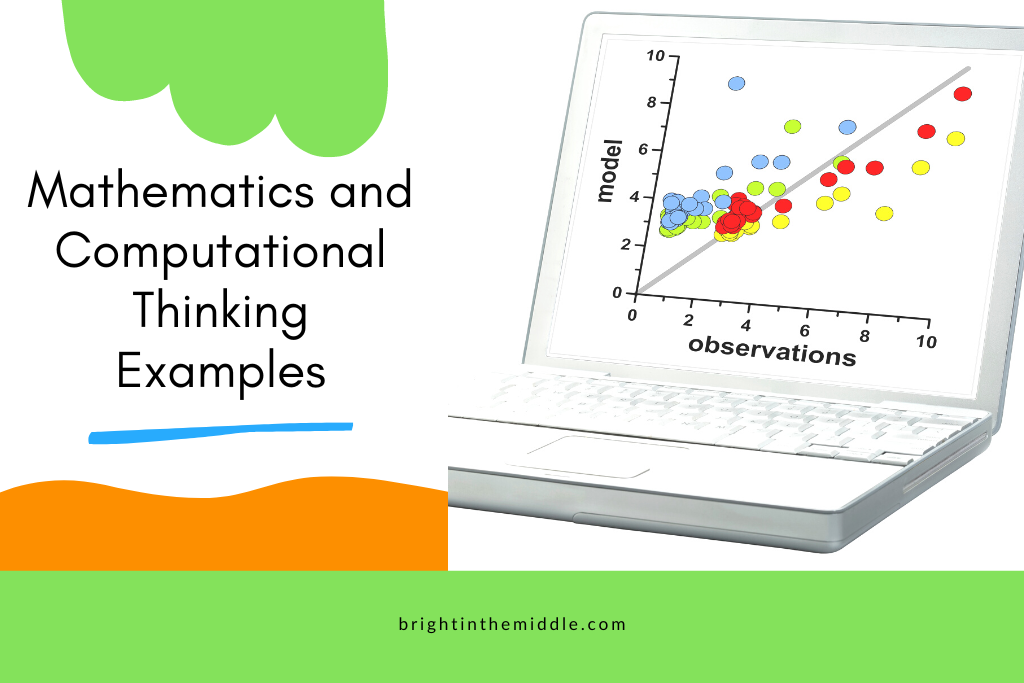
They should understand line graphs, bar graphs, pie charts, scatter plots, and even histograms.
After collecting data in class (or using sample data), your students should be able to determine what graph type will best represent the data.
What does this look like?
Example 1:
Let’s say your students have just completed an investigation where they explored the time it takes for a pendulum to complete a full swing at different initial lengths.
They will have an independent variable recorded (initial lengths) and the dependent variable recorded (period of oscillation).
They may determine that a scatter plot is the best way to visualize the data! Then, they can determine trends and patterns that occurred!
Example 2:
You could also use this SEP as a WONDER strategy to get students excited about a topic and become more familiar with data collection and visualization.
You could survey the class: “What is your favorite element on the periodic table?”. After calculating the number of students for different elements, have students to find the percentages and create a pie chart (or something else depending on what the data says).
This is a fun way to incorporate this SEP into your classroom and help students work on this skill set.
Use Technology to Collect and Analyze Data
The use of technology is taking over the classrooms, and science is no exception. I think that if technology is used in productive ways, it’s amazing to have in the classroom.
Technology can assist in all of the things mentioned above. It can help calculate formulas, especially if there is a large amount of mathematics to be done. In addition, it can be used to analyze large data sets and graph data. It can also be used in simulations and modeling.
What does this look like?
Example 1:
Science probes are a common tech tool to use to collect data during experiments. These devices will also connect to computer software that will display the data for students to analyze. They are amazing, and I highly recommend this brand.
One of my favorite sensors is the motion detector. These make amazing motion graphs if you teach this!
Example 2:
Don’t have extra money for the fancy tech. What about Google? You could easily use Google Forms to collect data from your students. For example, you could do a survey before teaching about the conservation of energy. You could create a Google Form for students to answer questions like “Do you turn the lights off when you leave a room to conserve energy?” or “Do you recycling paper, plastic, or other materials?”. Then, students can pull up the data in a spreadsheet and create a visual representation.
There are so many ways to include using mathematics and computational thinking in your classroom!
Help your students master science content!

Leave a Reply