Are you looking for ideas to add to your energy conservation lesson plan in your middle school science class? Maybe you just finished up teaching about renewable energy and nonrenewable energy and energy resources.
Even if it’s not a part of the curriculum, it’s essential to share with middle school students the importance of energy conservation. Currently, most of the energy in the world is generated by the burning of fossil fuels, which is a nonrenewable resource. We need to learn to conserve this resource, and in the process, look toward alternative energy sources to generate energy from.
Time to bring the WOW Factor to your energy conservation lesson plan! In this post, I share some WONDER strategies to get your students engaged in this lesson. Then, I share an interactive lesson that your students can go through to learn the importance of conserving energy and some energy conservation tips. Finally, I will share some WIDEN activities that your students can do to expand their knowledge on this topic.

WONDER Strategies for Your Energy Conservation Lesson Plan
This may or may not be an interesting topic for your students, so you have to get their buy-in. You can do that by using a WONDER strategy. These are strategies that you can implement to get your students excited about learning and help them to become internally motivated to learn. Once students are willing and wanting to learn, the rest is easy! Here are two ideas to add to your energy conservation lesson plan that you can try for this topic!
Look at Energy Data
Ok, ok….I know, data doesn’t seem to be one of those things that will get students excited about learning, but hear me out. If you really help them to dive into the data, there is a lot of interesting things to look at.
Guided Questions Approach
Pull up the U.S. Energy Facts Explained page.
First, look at the U.S. Primary Energy Consumption by Energy Source pie chart, and have students explore this question as a group: What are the primary sources of energy in the United States?
Then, move to the U.S. Primary Energy Product by Major Sources chart. Ask these questions.
- How has the mix of energy sources changed as time progressed?
- Do you see any trends in the use of fossil fuels, renewable energy, or nuclear energy?
- Why do you think the data looks this way?
It’s pretty neat to see some of the changes as well as the things that have not changed.
Student-Created Question Approach
Another way you can explore the data is by giving students the ownership in what they would like to explore.
- Give students 5-10 minutes to explore the U.S. energy data.
- Tell them that they will be “quizzing” their classmates. On a sheet of paper, they need to come up with 3 questions based on the data.
- Once all students have come up with their questions, have them switch questions with someone in the classroom.
- Students should answer the questions!
- Discuss the questions and answers as a class.

Huge List of Energy Use
This is a fun one to add to your energy conservation lesson plan!
- Tell your students to get out a piece of paper and have them write a list of all of the times they have used energy in the past week. Give them about 5 minutes to do this. Here are some examples: turned on the lights, heated their food in the microwave, rode in the car, took a hot shower, sat in an air conditioned room, charged their smartphone, etc.
- Once students have their list, they can talk with a partner to see if they get more ideas and have them to create a larger list.
- As a class, create an even larger list. How much energy was used as a class?
Students may not realize how much energy is used on a daily basis. We need to conserve, right? It’s a great way to explore ways energy is used. If anything, it’s a way to save money. Who doesn’t want to keep their money, right?
Now, they should be curious about how they can conserve energy and why it may be important, so now it’s time to dive into the energy conservation lesson!
Conservation of Energy Lesson – It’s interactive!
As mentioned, at this point, students should have already learned about energy resources, so now it’s time to explore how to conserve them.
Interactive lessons are so fabulous! They are designed to teach the content with retaining it in mind. The way they are set up is so that students will learn a little bit of content, and then students will answer a question or do an activity to help them process that information!

In this Conservation of Energy Resources lesson, students will learn the energy conservation definition, the importance of conserving fossil fuels, different ways of energy conservation, reduce, reuse, recycle, the consequences of the depletion of natural resources, and more! It’s not your average ways to conserve energy PPT!
Inside of the lesson (or review), students will answer embedded questions and do other activities such as a KWL, four corners vocabulary, exploring outside resources, conservation of energy videos, and more!
It’s the perfect addition to your energy conservation lesson plan!
Energy Conservation Activities to WIDEN Knowledge
So, students have learned all about energy conservation, and now it’s time to WIDEN their knowledge so they can learn more about this topic! It’s also a great way for students to apply what they have already learned. Here are some WIDEN activities for you to implement into your classroom. Skip the energy conservation worksheet and try these!
Build Something with “Waste” Materials
Students are so creative, so now it’s time to let them practice what we preach! One of the things that you can do to conserve energy is to recycle or to upcycle.
This is their opportunity to create something great with materials. Upcycling is using materials and making a new product with it that is of greater value and quality. Over the week (or even month) before, start collecting “recycled “waste” materials. Encourage the students to bring in stuff and even the staff in your school. Collect things such as paper towel rolls, old magazines, scrap wood, old fabric, tin cans, cardboard boxes (Yes, all of those Amazon boxes!), plastic bottles, and more. Whatever is not gross that you would normally throw away!
- Have your students to pick a project that they would like to create with the old materials. Some examples might be a birdhouse, a piece of artwork, simple furniture like a stool, planters, a playhouse, masks, sketchbooks, jewelry, etc. They can get as creative as they would like!
- Once students have their old materials and their idea, they can start creating! You may also need things such as paint, glue, scissors, markers, a hot glue gun, etc.
- After students finish, they can show off and present their creation. You can even display the best of the best in the classroom or the media center in your school.
Students will have fun with this! This is perfect for your energy conservation lesson plan because upcycling allows materials to be kept longer, using lesson energy and reducing waste.
Conservation of Energy RAFT
I love RAFT assignments because they let students show off their creative writing style! It’s a great way to increase scientific literacy in the classroom!
Remember, a RAFT is a piece of writing where:
R: Role – such as a scientist, historical figure, survivor – It’s the person “writing” the piece.
A: Audience – such as a pet, future employer, classmate – It’s who the piece is being written to.
F: Format – such as a letter, speech, article – It’s the format the piece is written in.
T: Topic – such as a memory, a current event, an important issue – It’s the topic of the writing piece.
You can choose anything for each of these letters, or you can even have students to choose, but here’s an example for this topic.
- R: Student
- A: The School Board
- F: A Letter
- T: Ways of Energy Conservation in the School District
Here’s another example:
- R: Energy Detective
- A: Classmates
- F: Poster
- T: Ways to Conserve Energy in your House
This can be a lot of fun and help students really dive into the content.
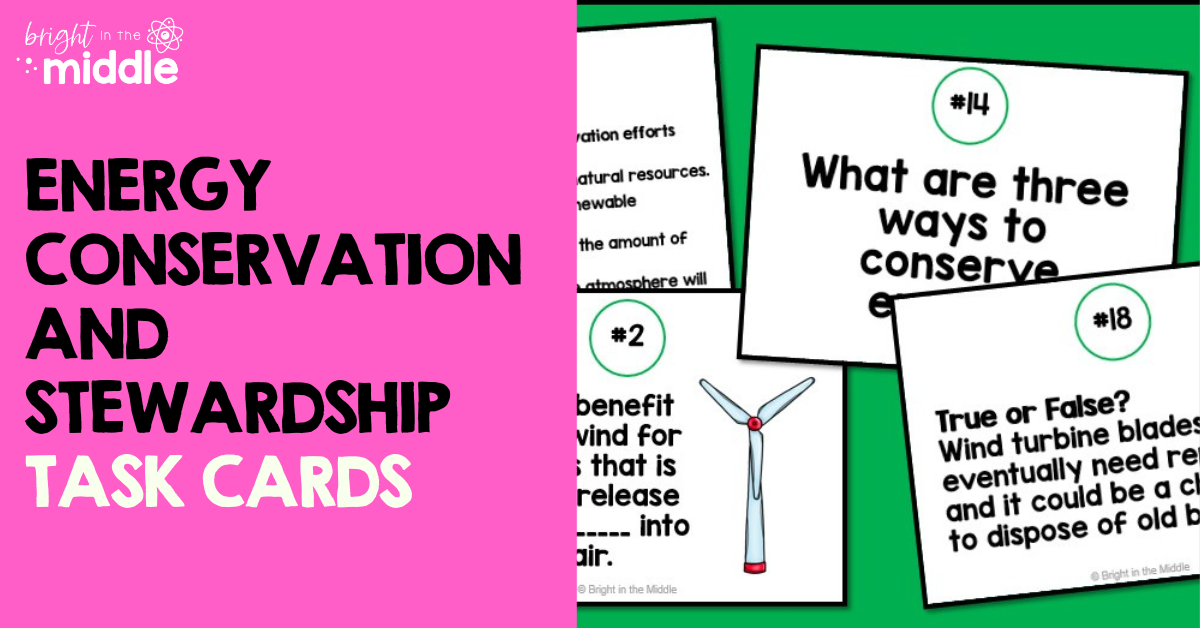
Bonus: Energy Conservation Task Cards
If you are looking for a good review for the conservation and stewardship of Earth’s renewable and nonrenewable energy resources, look no further!
These task cards were created to fit NC 8th grade science standard ESS.8.4.4 “Obtain, evaluate, and communicate information to compare the long term implications of the use of renewable and nonrenewable energy resources and the importance of stewardship and conservation.”, but it also fits many other state standards!
I absolutely love task cards, and these are great for helping students really think about the advantages and disadvantages of using different energy resources.
These will go great with any energy conservation lesson plan!
Have fun creating your energy conservation lesson plan with these ideas!
Help your students master science content!

Leave a Reply