Description
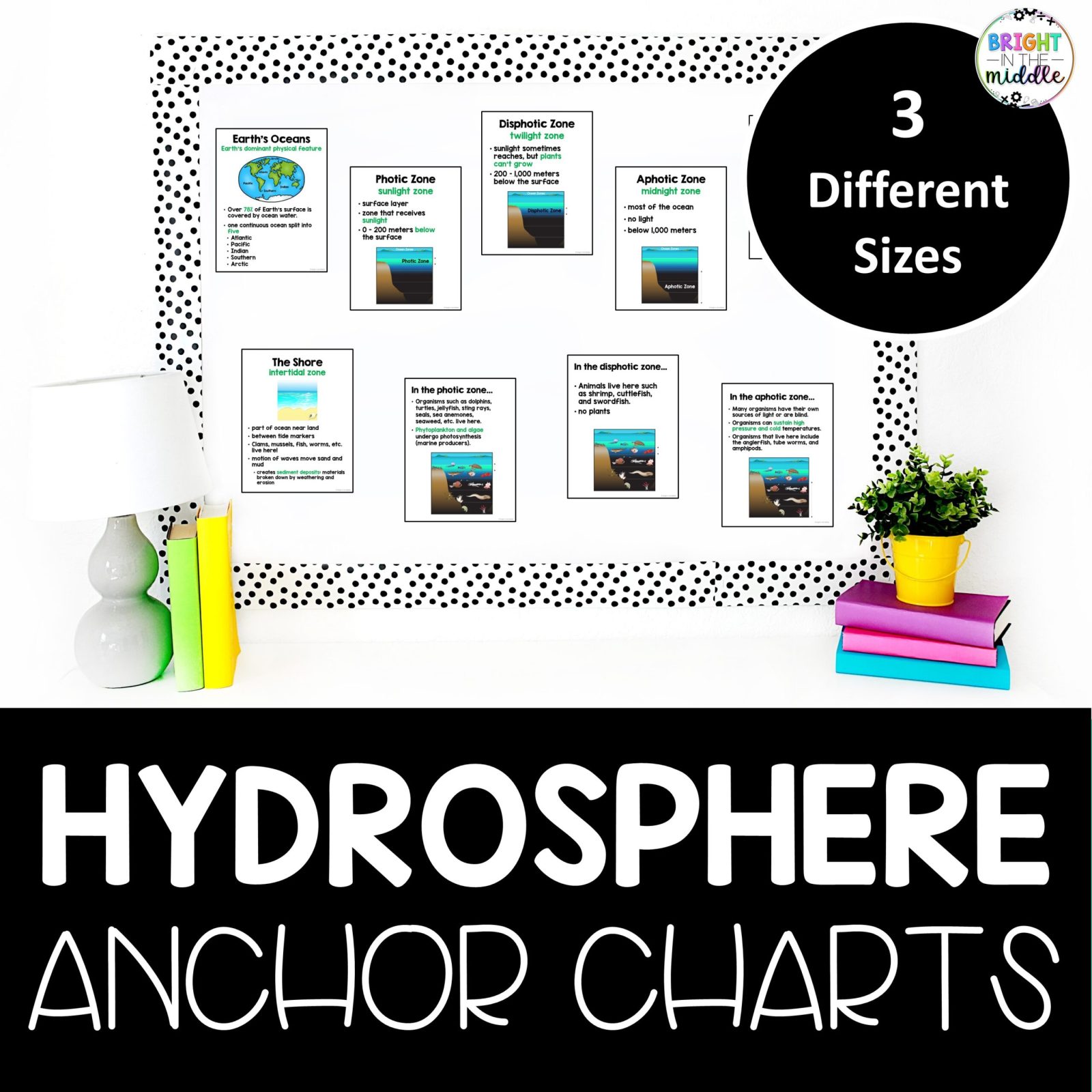
These beautiful hydrosphere anchor charts will be a great addition to your middle school science classroom. Why keep repeated yourself to help your students remember information? This resource will be a life-saver for your voice!
These can be used as mini-anchor charts, a bulletin board idea, posted on the wall, put into interactive notebooks, and so much more!
In this set, you will receive THREE different sizes!
- Frame Size
- Half-Sheet
- Full-Sheet
This set of science anchor charts was designed to accompany those adorable white frames from IKEA/Amazon, but they also work great for bulletin boards and interactive notebooks!
These Hydrosphere charts cover:
- hydrogen bonds
- properties of water
- polarity
- capillary action
- adhesion
- cohesion
- surface tension
- specific heat
- density
- water as the universal solvent
- solute and solvent
- salinity
- Earth’s spheres
- the water cycle (hydrologic cycle)
- land and water on earth’s surface
- saltwater vs. freshwater
- watersheds
- wetlands
- river basin
- aquifer
- how the ocean gets salty
- hydrothermal vents
- salinity in water
- Earth’s oceans
- ocean basis
- the shore
- photic zone, disphotic zone, aphotic zone
- plankton, nekton, benthos
- oceans as a reservoir
- ocean currents
- upwelling
- dissolved gases
- evaporation, transpiration, condensation, precipitation, sublimation, deposition, surface runoff, infiltration, groundwater storage, freshwater storage
- physical water quality indicators
- chemical water quality indicators
- biological water quality indicators
- point source and non-point source pollution